Table of Contents
Search Engine Marketing Consulting Services | Cost & Process
Quick Answer
Hiring an SEM consultant means someone reviews your business and budget, researches which keywords are worth paying for, then builds your Google Ads and Microsoft Ads accounts around that research with copy and landing pages built to convert. The step most accounts skip is conversion tracking, and it decides whether any of this works. Without it, you know how many clicks you got and nothing about which ones became customers.
A consultant worth paying for, the kind Reliantware brings to every engagement, sets that tracking up from day one and optimizes against real revenue, not traffic alone.
Key Takeaways
- SEM consulting covers strategy, keyword research, account structure, ad copy, and ongoing optimization, not just running ads.
- Consulting means advice you implement yourself; management means someone else runs the campaigns for you, and the two are priced differently.
- Pricing typically follows one of four models: hourly, monthly retainer, percentage of ad spend, or project based.
- Conversion tracking is the single most skipped step, and without it you cannot know which clicks became customers.
- CPA and ROAS matter more than CTR or impressions when judging whether a campaign is actually profitable.
- AI search and GEO are now a standard part of SEM strategy, not an optional add-on.
- Reliantware builds every SEM and SEO engagement around real conversion data and revenue, not vanity traffic metrics.
What Search Engine Marketing Consulting Actually Includes
Search engine marketing consulting means strategy, keyword research, campaign structure, ad copy, tracking, and ongoing optimization, all built around what your business actually needs. It is not simply running Google Ads. Anyone selling it that way is selling you the easy version.
A consultant who actually knows this work starts somewhere else entirely. They figure out what a customer is worth to you first. Then they reverse engineer the whole campaign around that number, not the other way around.
Take a dental clinic as an example. A consultant would separate searches like “dentist near me” and “emergency dentist” from lower value ones like “what does a root canal feel like.” The first group signals someone ready to book. The second is research, not intent. Bidding on both the same way wastes money on the searches least likely to become patients.
Strategy and Business Analysis
Before any account gets touched, the consultant needs to understand the business behind it. That means the products or services offered, the target customer, the geographic market, average customer value, and the existing marketing performance. A local plumber and a national SaaS company need completely different SEM strategies even if their monthly budgets look identical.
Keyword Research and Intent Mapping
Take an HVAC company. “Emergency AC repair” is someone with a broken unit and a credit card in hand. “How does an AC work” is someone doing homework, nothing more. Budget should chase the first group hard and mostly ignore the second.
And negative keywords matter just as much here. Add them, and you block the searches that look relevant but never turn into a customer. Skip them, and you are paying for clicks that were never going anywhere.
SEM Consulting vs. SEM Management, and Why the Difference Matters
SEM consulting means advice and strategy. SEM management means someone else runs the campaigns for you. Businesses often use the terms interchangeably, and that confusion causes real problems when expectations do not match what gets delivered.
A consultant hands you the advice, not the execution. Separate your commercial keywords into dedicated ad groups. Add these fifteen negative keywords this week. Your team does the actual work from there.
Management is a different deal entirely. The agency builds the campaigns, writes the ads, adjusts the bids, sends you a report every month. You barely touch the account yourself.
Some firms offer both. But they are not the same service, and mixing them up gets expensive fast. Paying for full management when all you needed was direction is one of the easiest ways to overspend in this category.
What SEM Consulting Costs
Pricing depends heavily on business size, ad budget, competition in your industry, and how much ongoing work you actually need. Most providers fall into one of four pricing structures, and picking the wrong one for your situation is more common than it should be.
|
Model |
Description |
Best For |
|
Hourly Consulting |
Paid per hour of expert time and advice |
Businesses with an internal team that just need direction |
|
Monthly Retainer |
Fixed monthly fee for ongoing management and reporting |
Companies running continuous campaigns |
|
Percentage of Ad Spend |
Fee calculated as a share of your monthly budget, often around ten percent |
Larger budgets where scaling fees with spend makes sense |
|
Project Based |
Flat fee for a defined deliverable like an audit or account rebuild |
One time needs such as a full account restructure |
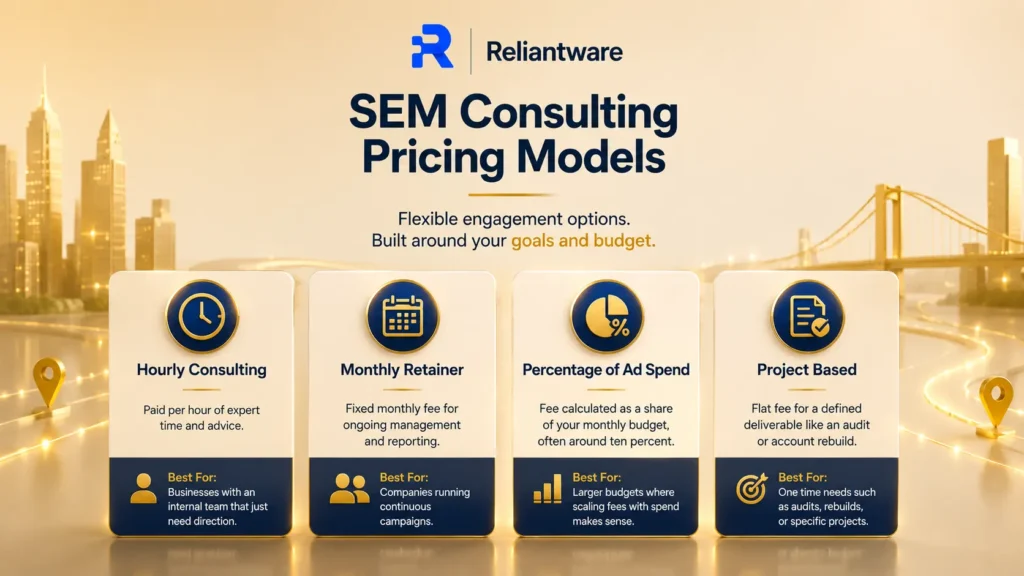
A ten thousand dollar monthly ad budget at a ten percent management fee works out to roughly one thousand dollars, though the exact percentage varies by provider. Project based work, like a full account audit, usually gets quoted as a flat fee tied to the scope rather than time spent.
The Metrics That Actually Matter
Clicks and impressions feel good to look at. They rarely tell you whether the campaign made money. A handful of metrics do that job properly, and any consultant worth hiring will report on these instead of leading with vanity numbers.
Click through rate (CTR) measures how often people click your ad after seeing it: clicks divided by impressions, times one hundred.
Cost per click (CPC) is your total spend divided by total clicks, showing what each visitor actually cost you. Platforms like Google Ads score your ads and landing pages on relevance, which directly affects how much you pay per click.”
Conversion rate shows what share of visitors complete a real action, calculated as conversions divided by clicks, times one hundred.
Cost per acquisition (CPA) divides ad spend by conversions, telling you what it costs to generate one customer.
Return on ad spend (ROAS) is revenue divided by ad spend. Ten thousand dollars in revenue against two thousand in spend gives you a five times return, which is the number that actually justifies the budget.
Cost per lead (CPL) divides spend by leads generated, the metric that matters most for businesses selling through a sales team rather than a checkout page.
If a report only mentions clicks and impressions, ask why CPA and ROAS are missing. That is usually the sign of an account nobody has connected to real revenue.
How AI Search Is Changing What SEM Consulting Covers
Search itself is fragmenting. Buyers now find businesses through AI generated answers in tools like ChatGPT and Google AI Overviews, not only through a traditional results page. This is no longer an emerging edge case. It is already reshaping where SEM budgets and strategy need to point.
A consultant working in this space today should be thinking about generative engine optimization, often shortened to GEO, alongside paid search. That means structuring content and campaigns so a brand gets referenced when someone asks an AI tool a buying question, not just when they type a search into Google. Agencies that treat this as optional are already behind. For most businesses, the SEM strategy that ignores AI search visibility is leaving a growing share of buyer discovery on the table.
How to Evaluate an SEM Consultant
A polished homepage tells you nothing. Some of the worst hires in this space come from businesses that judged a consultant on how good their website looked.A few concrete checks actually separate a real partner from someone selling you clicks.
Ask for their approach to conversion tracking before you sign anything. If they cannot describe how they will connect ad spend to actual revenue, that is a real problem, not a detail to sort out later. Ask whether their reporting leads with CPA and ROAS or with traffic and impressions. Ask for a specific example of how they identified and cut wasted spend on a past account. And ask directly whether the engagement is consulting or management, since the answer changes both the price and what you are actually buying.
This is the kind of framework we walk businesses through at Reliantware before recommending any SEM approach, because the wrong fit here costs real money fast. Get a free audit at Reliantware and we will tell you honestly whether SEM, SEO, or both make sense for where your business is right now.
Common Mistakes That Waste SEM Budget
- Judging performance by CTR and impressions instead of CPA and ROAS. A high click through rate on unprofitable traffic is not success.
- Skipping conversion tracking before launch. Without it, you are spending money and guessing at the results.
- Hiring for full management when a one time audit was the actual need. Paying a monthly retainer for a problem that needed a single account restructure is a common overspend.
- Ignoring negative keywords. Searches that look relevant but never convert, like “free” or “DIY” variations of your core terms, quietly drain budget every month they go unaddressed.
How to Choose the Right Engagement Model

If you already have an internal marketing team and just need direction, a one time audit or hourly consulting will usually cover it. If you are running campaigns continuously and want someone else driving day to day, a monthly retainer fits better. Larger budgets focused strictly on ROI sometimes favor performance based pricing, where fees scale with results rather than time.
The honest limitation here: SEM consulting is not the right investment for every business. A company still finding product market fit, or working with a budget too small to gather meaningful conversion data, will often get more value from fixing the offer or the website first. Paid search amplifies what is already working. It does not fix what is broken underneath it.
Conclusion
The value of search engine marketing consulting services is not measured in clicks. It is measured in how much profitable business the advertising actually generated. A consultant who can show you real ROAS numbers, a clear conversion tracking setup, and a strategy that accounts for how AI search is already changing buyer behavior is worth paying for. One who only talks about traffic and impressions is not.
If you are trying to figure out whether your business needs SEM, SEO, or a combination of both, Get a free audit at Reliantware today.
FAQs
How much does an SEO consultant cost?
Rates typically run $75 to $200 an hour, $1,500 to $5,000 monthly for retainers, or a few thousand for a one time audit, depending on business size and competition.
How much should I pay for a marketing consultant?
Most consultants charge $100 to $300 an hour or $2,000 to $10,000 monthly, depending on your budget and how much ongoing work you need.
How much does it cost for search engine marketing?
SEM costs cover both ad spend and management fees, with management typically running 10 to 20 percent of ad spend or a flat monthly retainer.
Can a beginner do SEO?
Basic fixes like titles and meta descriptions are beginner friendly. Technical SEO and competitive keyword strategy usually need real experience.
Can ChatGPT do SEO?
ChatGPT can help with keyword ideas and drafts, but it cannot audit technical issues or track real rankings, so it works better as a starting point.
Is it worth paying for SEO services?
For most businesses in a real market, yes. The return usually comes from time saved and mistakes avoided rather than the hours themselves.
Is SEO still relevant now, with AI search growing?
Yes, arguably more. AI tools pull answers from indexed, well structured content, so ranking well and getting cited now depend on the same fundamentals.
Should I hire an SEO agency or do it myself?
DIY can work for small, low competition sites with time to spare. Once competitors invest in SEO, an agency usually closes the gap faster. Reliantware’s free audit shows where you stand before deciding.
Is SEO dead now with AI?
No. AI search still relies on crawling, indexing, and ranking, so SEO fundamentals still matter. Visibility now also means getting cited inside AI answers, not just ranking on a page.
Losing Leads to AI Search Costs You $4,000+/Month. Fixing It Costs $0 in Ads.
Your customers ask ChatGPT and Google which company to hire. Show up there, and they call you.
Free.
Claim your Growth Plan now. No obligation