Table of Contents
AI Search Engine Optimization Services 2026| Get Cited by AI
Quick Answer
AI search engine optimization gets your business named directly inside ChatGPT, Gemini, Claude, Perplexity, and Google AI Overview answers, not just ranked on a results page. It runs on clean entity and schema data, direct answer content, and technical fixes AI crawlers can actually read. Pricing scales with your services and locations, results build over four to eight weeks, and no honest provider guarantees a citation. Reliantware builds its programs on exactly that honesty, clean data and real process over empty promises.
Skip entity consistency and none of it works. One AI system finding three different phone numbers for your business will not risk recommending you.
Key Takeaways
- AI search optimization targets citations inside AI generated answers, not just position on a results page.
- Coverage needs to span both Google’s AI layer and the independent large language models, since each pulls information differently.
- Entity consistency across your website, directories, and social profiles is usually the highest leverage fix available.
- Results build over weeks, and any provider promising a specific citation count is overstating what the category can currently deliver.
- Reliantware structures its AI SEO programs around honest timelines and verifiable process, guaranteed rankings, which is the standard worth holding any provider to.
What Is AI Search Engine Optimization?
AI search engine optimization covers two related but distinct disciplines. Generative engine optimization, often shortened to GEO, focuses on getting your business cited or recommended inside an AI generated answer. Answer engine optimization, or AEO, is nearly the same idea applied specifically to direct question and answer formats. Separately, AI driven traditional SEO uses machine learning tools to speed up classic search engine work like keyword clustering, technical audits, and content drafting.
The distinction matters because businesses often buy one and assume they got the other. A tool that automates your meta descriptions faster does not make ChatGPT trust your brand. Getting named inside an AI answer requires a different kind of evidence entirely.
Picture two competing HVAC companies. One ranks fourth on Google for emergency repair. The other ranks eighth on Google but gets named directly when someone asks an AI assistant who to call at midnight. The second business wins the customer even though its traditional ranking is worse. That gap is exactly what AI search engine optimization services are built to close.
How Is AI SEO Different From Traditional SEO?
Traditional SEO chases a ranking position on a results page. AI SEO chases a citation inside a generated answer. The two goals overlap in places, since strong technical SEO and clean structured data help both, but the finish line is not the same.
|
Traditional SEO |
AI SEO or GEO |
|
|
Primary Goal |
Rank high in search results |
Get cited inside AI generated answers |
|
Target Platforms |
Google, Bing |
ChatGPT, Gemini, Claude, Perplexity, Copilot, Google AI Overviews |
|
Core Metric |
Clicks, keyword position, impressions |
Citation frequency, share of voice, zero click visibility |
|
Optimization Focus |
Keywords, backlinks, title tags |
Entity clarity, structured data, direct answers |
Notice the metric row. A page can rank on page one and still never get quoted inside an AI answer, and a page can rank nowhere near the top and still get cited constantly because the AI trusts the source. Those are two different games, and most agencies still only play one of them.
Which AI Platforms Does This Actually Cover?
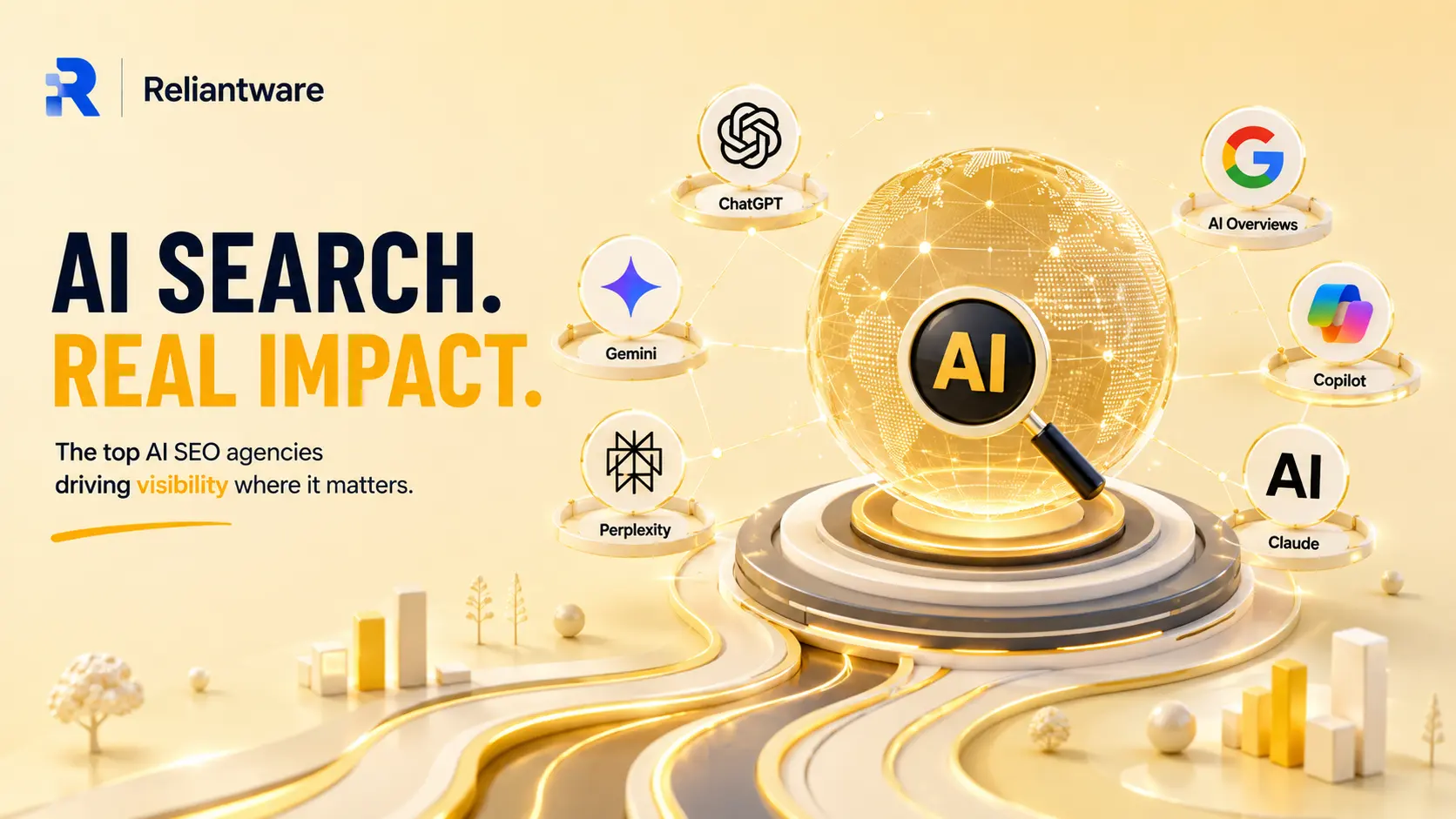
A serious AI search engine optimization program covers Google’s own AI layer and the independent large language models separately, because they pull information in different ways.
Google’s AI layer includes AI Overviews and AI Mode, both of which draw heavily from Google’s existing index and its Knowledge Graph. If your technical SEO and schema are already strong, this layer often follows naturally.
Then there are the independent AI models. ChatGPT, Gemini, Claude, and Perplexity don’t all work the same way. Each combines live web information with what it has already learned, and each decides which sources to trust differently. Microsoft Copilot leans more on Bing’s search index. So if you’re only optimizing for Google’s AI results, you’re missing a big part of where people are discovering businesses.
What Does an AI Search Engine Optimization Service Actually Do?
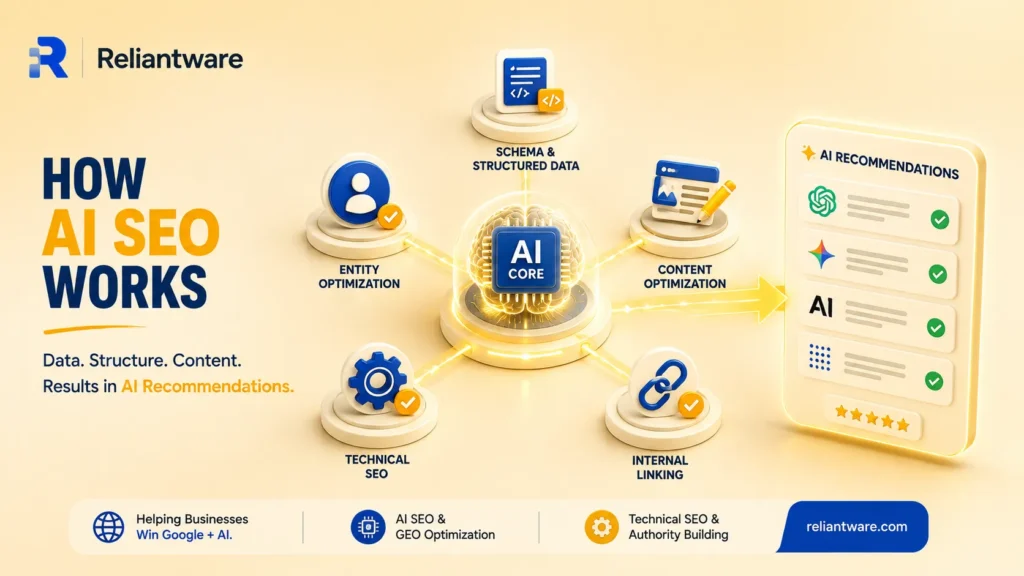
A real AI SEO engagement centers on three things. Entity and schema work establishes who you are in a way machines can parse instantly, using JSON LD markup for your organization, services, and locations. Content restructuring means rewriting important pages so they answer the main question right away instead of starting with a long introduction. AI doesn’t read pages the way people do. It looks for clear, useful passages it can pull into its answers. Technical work confirms that crawlers, including AI crawlers, can actually reach and read your site without running into blocked resources or broken markup.
In our experience at Reliantware, the businesses that see the fastest movement are the ones with the messiest starting data. If your address is written three different ways across your website, your directory listings, and your social profiles, fixing that inconsistency alone often produces a noticeable shift.Get a free audit at reliantware and see exactly where yours stands.
Internal linking matters more than most people realize. When your pages connect in a clear structure, AI can better understand your main services and how everything fits together. Without that structure, your pages can end up competing with each other and sending mixed signals. It’s not the flashiest part of AI SEO, but once your business information is clear, it’s often one of the changes that makes the biggest difference.
Current AI search snapshot for August 2026: Google AI Overviews now appears on a large share of informational queries, ChatGPT and Perplexity continue expanding real time web retrieval, and Microsoft has pushed Copilot deeper into Bing and Windows search surfaces. The specific platforms worth prioritizing shift as adoption changes, so this list gets checked monthly.
How Much Does AI Search Engine Optimization Cost?
Pricing across the industry typically scales with the number of core services and locations being optimized rather than a single flat retainer. A business with one or two clearly defined services costs less to optimize than a multi location company with a dozen service lines, simply because there is more content and more schema to build correctly.
The honest answer is that anyone quoting you a price before reviewing your site and your service list is guessing. A real quote follows a scoping review, not the other way around.
How Long Does It Take to See AI Citation Results?
Most businesses start to notice early movement within four to eight weeks, with more consistent citation patterns building over two to three months. That timeline reflects how AI systems actually work. They do not update their trust in a source instantly. They need repeated exposure to consistent, accurate information before they treat a business as a reliable citation.
Most of the work during this stage isn’t exciting. You’re adding schema, improving service pages, and fixing business listings. The results usually come later, when an AI assistant starts recommending your business in answers where it never appeared before.
Consider a regional accounting firm with three office locations and inconsistent listings across a dozen directories. Correcting those listings alone does nothing overnight. But once every source agrees on the same name, address, and service list, an AI system stops treating the business as an ambiguous entity and starts treating it as a verified one. That shift in trust, not any single piece of content, is usually what unlocks the first citation.
Can You Guarantee Your Business Gets Cited by ChatGPT or AI Overviews?
No, and any provider who promises a specific citation result is telling you something they cannot back up. AI systems change their retrieval logic without notice, and no agency controls what any given model decides to surface for any given prompt. That is simply the honest limitation of this entire category right now.
What a good provider can promise is a defensible process. Clean entity data, strong schema, and content structured for direct answers all measurably improve your odds. None of it converts to a guarantee, and you should be skeptical of anyone who tells you otherwise.
How Do AI Systems Decide Which Businesses to Recommend?
Here is the distinction most explanations skip. An AI system draws on two very different sources depending on the platform and the query. Training data recall pulls from whatever the model absorbed during its original training, which can be months or years out of date. Live retrieval pulls from a current web search the model runs in real time, closer to how a search engine works.
Businesses chasing AI visibility often optimize only for one and wonder why nothing changes. If a platform relies on live retrieval for your type of query, static training data mentions will not move the needle. If it relies on training recall, no amount of fresh content will help until the next training cycle. Knowing which situation applies to your target queries changes where you spend effort first.
Google’s own developer documentation confirms this directly, describing retrieval augmented generation as the mechanism its AI features use to pull current, relevant pages from the Search index rather than relying on static training data.
Common Mistakes Businesses Make With AI Search Optimization
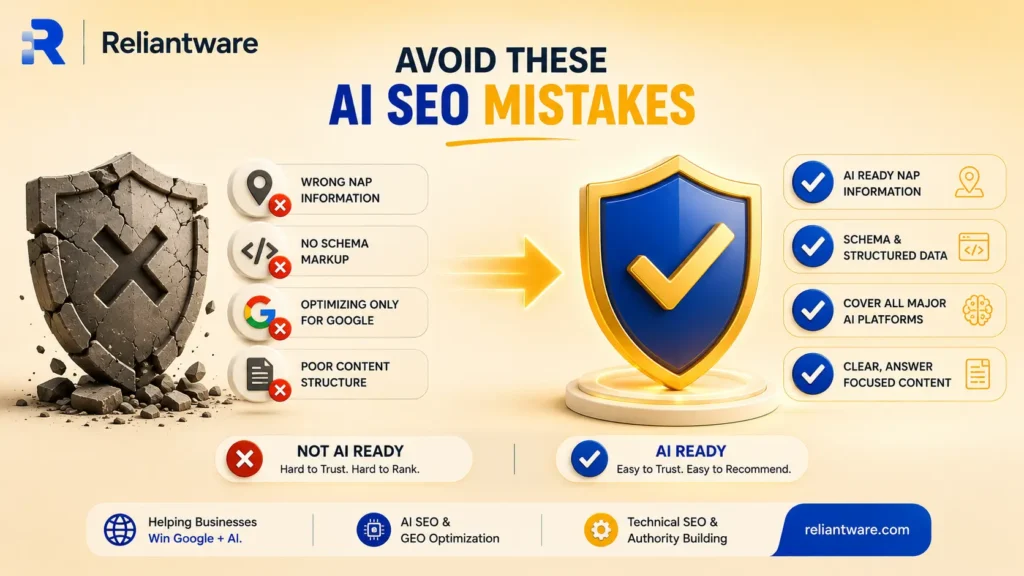
Inconsistent business information across your website, directories, and social profiles confuses entity recognition faster than almost anything else.
Optimizing only for Google while ignoring ChatGPT, Perplexity, and Copilot leaves real visibility on the table, since customers are spread across all of them.
Treating this as a one time project instead of ongoing signal maintenance wastes the early investment, because AI platforms reevaluate sources continuously.
Trusting any provider who guarantees specific citation results is a red flag every time, not an exception.
Skipping structured data entirely makes it far harder for any AI system to parse what you actually offer.
How to Choose an AI Search Engine Optimization Provider
Ask three questions before signing anything. First, can they explain in plain language how their work is supposed to influence citation behavior, or do they only talk about rankings. Second, do they have documented schema and structured data experience, since that remains one of the highest impact technical inputs available. Third, will they tell you honestly that results take weeks, not days.
A provider who dodges the honest limitation question, or who leans on an unverifiable growth statistic instead of a clear process explanation, is worth walking away from. The category is new enough that overpromising is common. The providers worth hiring are the ones willing to tell you what they cannot control.
Conclusion
AI search is not a future consideration anymore. It is already shaping how customers find businesses today, and the companies building clean entity data and strong structured content now will be harder to displace once their competitors catch up. Waiting does not make the work easier later. Get a free audit at Reliantware and find out where your current gaps actually are.
FAQs
Can AI do search engine optimization?
AI handles parts of SEO well, like keyword clustering, content drafting, and technical audits, but it still needs human judgment for strategy and nuance. Most effective SEO today blends AI speed with human oversight rather than running on full autopilot.
How do I learn SEO as a beginner?
Start with how search engines crawl and index pages, then move into on page basics like titles and headers, then keyword research and content structure. Free resources from Google Search Central plus hands on practice on a real site teach faster than theory alone.
What is the best AI for search engine optimization?
No single AI tool covers everything. Most SEO teams combine several, one for keyword research, one for content drafting, one for technical audits. The tool matters less than the strategy guiding it, which is exactly where an agency like Reliantware fits in.
How much does AI search optimization cost?
Pricing typically scales with how many services and locations need optimizing, not a flat monthly rate. Reliantware and most serious providers quote after reviewing your site and service list, never before it.
Can ChatGPT do SEO?
ChatGPT can draft content, brainstorm keywords, and outline pages, but it cannot crawl your live site, check technical issues, or guarantee rankings. It works best as one tool inside a broader SEO process, not a replacement for one.
Is SEO dead or evolving in 2026?
Evolving, not dead. Search behavior has shifted toward AI powered answers and zero click results, so SEO now covers traditional rankings and AI citations together. Businesses adapting to both stay visible.
What is SEO being replaced by?
Nothing is fully replacing it. SEO is expanding to include generative engine optimization, the practice of getting cited inside AI answers, alongside classic ranking work. The skill set is broadening, not disappearing.
What are the 4 types of SEO?
Technical, on page, off page, and local. Technical covers crawlability and site health, on page covers content and structure, off page covers backlinks and authority, and local covers map and near me visibility.
What is the biggest threat to SEO in 2026?
Losing visibility inside AI generated answers while still ranking fine on a traditional results page. Businesses tracking only keyword position and ignoring AI citation are the ones most likely to get blindsided.
Losing Leads to AI Search Costs You $4,000+/Month. Fixing It Costs $0 in Ads.
Your customers ask ChatGPT and Google which company to hire. Show up there, and they call you.
Free.
Claim your Growth Plan now. No obligation