Table of Contents
Innovative SEO Ideas to Rank on Google and Get Cited by AI (2026)
Quick Answer
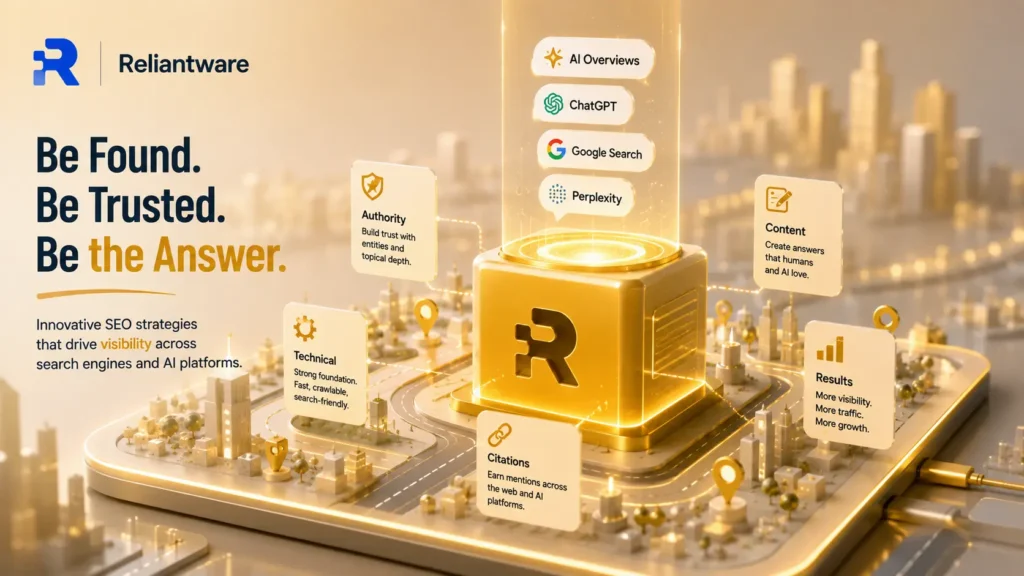
Innovative SEO means optimizing a business to be found and recommended everywhere people search, not just Google. It combines a solid technical foundation, content structured for clear AI and reader answers, entity and topical authority, and optimization for AI Overviews, ChatGPT, and Perplexity. Success gets tracked across rankings, traffic, AI citations, and real conversions together, not one metric alone. Skip a piece and it shows.
Strong AI visibility with weak technical SEO still loses traffic. Solid technical SEO with no entity clarity never earns an AI mention. Reliantware builds all of it together, not as separate projects.
Key Takeaways
- Innovative SEO means being found everywhere people search, not just ranking on Google.
- A solid technical foundation, fast load times, clean architecture, full crawlability, comes first.
- Content must give clear, direct answers that both readers and AI systems can extract.
- Entity and topical authority tell search engines and AI models exactly what your business does.
- GEO specifically targets visibility inside AI Overviews, ChatGPT, and Perplexity.
- Track rankings, traffic, AI citations, and conversions together, never just one metric.
- Reliantware builds all five pieces as one connected strategy, not separate projects.
What Is Innovative SEO
Innovative SEO means optimizing your brand’s visibility everywhere customers actually search, including AI powered tools, not just chasing rankings for one page on one search engine. Traditional SEO treats each page like a contestant competing for a keyword. Innovative SEO treats the whole brand as something that needs to be understood, trusted, and recommended, wherever the question gets asked.
Picture two businesses selling the same service. Business A writes one solid page targeting “accounting software for small business” and earns a handful of backlinks. Business B does that too, but also builds a cluster of related content, structures every page with clear answer blocks, earns genuine mentions across industry publications, and makes sure its schema markup tells search engines exactly who it is and what it does. When someone asks ChatGPT for accounting software recommendations, Business B has a real shot at being named. Business A does not, because nothing about its content taught an AI system who it is.
That difference is the whole idea behind innovative SEO. It is not a replacement for classic ranking factors. It is what gets built once those factors are solid.
How Innovative SEO Differs From Traditional SEO
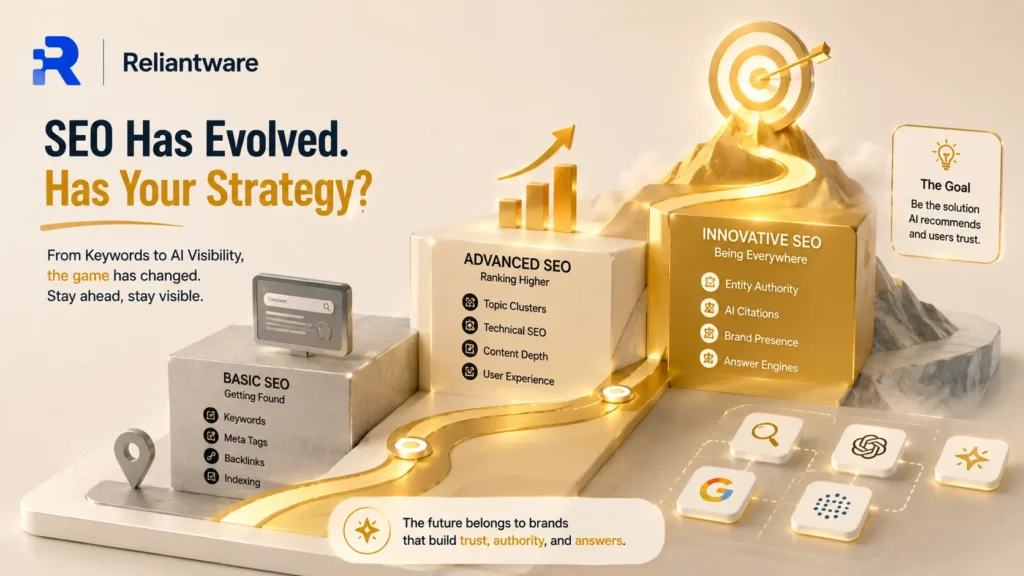
Traditional SEO chases rankings. Innovative SEO chases presence. The two overlap heavily but the priorities shift once you compare them side by side.
|
Focus |
Basic SEO |
Advanced SEO |
Innovative SEO |
|
Primary Goal |
Indexability and keywords |
Higher keyword rankings |
LLM citation and brand presence |
|
Content Strategy |
Blog posts on high volume terms |
In depth topic clusters |
High information gain assets and schema |
|
Technical Focus |
On page meta tags and basic XML |
Site speed and crawl budget |
Structured AI schema and entity graph |
|
Tracking Metrics |
Keyword positions and organic traffic |
Conversions and backlink profile |
Brand mentions across AI engines |
Notice the pattern. Each tier builds on the last rather than replacing it. A business skipping straight to innovative tactics without solid technical SEO underneath is building on sand. The foundation still has to hold.
Generative Engine Optimization and AI Citation
Generative Engine Optimization, or GEO for short, is about structuring content so AI systems actually cite it when they generate an answer instead of just handing back a list of links. Google AI Overviews already reach billions of users every month, and tools like ChatGPT Search and Perplexity pull straight from the open web to build their responses. GEO is how a brand earns its spot inside that answer.
How AI Overviews and ChatGPT Choose Sources
AI systems tend to cite pages that state facts clearly, use descriptive headings, and answer a question directly within the first sentence or two. Vague marketing language rarely gets pulled into a generated answer. Specific claims do. A page that says “we help businesses grow” gets ignored. A page that says “the average client sees measurable ranking improvement within three to six months” has something concrete to extract.
Structured data plays a role too. JSON-LD schema, particularly Organization, Author, and FAQPage markup, gives AI systems machine readable context about who published the content and what it covers. That is not a ranking factor in the traditional sense. It is a trust and comprehension signal.
Structuring Content for AI Retrieval
Every section of a page built for GEO should work as a standalone unit. That means opening each heading with a direct answer, keeping paragraphs self contained enough to make sense without the surrounding text, and avoiding vague references like “as mentioned above.” AI tools often extract individual paragraphs rather than whole pages, so each one needs to carry its own complete thought.
Entity SEO and Topical Authority
Entity SEO means structuring your brand and content around recognizable concepts and relationships rather than isolated keywords, so search engines understand who you are and what you specialize in. Instead of stuffing a page with “SEO agency restaurant marketing,” entity SEO builds a clear relationship map. This agency specializes in AI SEO. It serves restaurant businesses. It operates in the United States. Search engines and AI models increasingly reason in relationships like these, not just word matches.
Building Entity Relationships
Consistency drives entity clarity. The same business name, description, and service categories need to appear the same way across the website, business directories, social profiles, and any third party mentions. Inconsistent descriptions confuse the entity graph search engines build. A business calling itself “SEO consultancy” on one page and “digital marketing agency” on another sends mixed signals about what it actually does.
Creating Topic Clusters That Signal Expertise
Topical authority replaces the old keyword to article model with a topic to cluster to authority model. Writing one article about restaurant SEO proves very little. Writing an entire connected library covering restaurant keyword research, local SEO for restaurants, restaurant link building, and restaurant schema tells search engines this business genuinely understands the space. Internal links tying those pages together reinforce the signal.
Schema Markup for Innovative SEO
Schema markup is structured code added to a page that tells search engines and AI systems exactly what the content means, rather than leaving them to infer it from raw text. JSON-LD is the most common format, and it typically covers Organization details, Author credentials, and FAQPage question and answer pairs, all defined by the Schema.org vocabulary.
Schema itself is not a direct ranking factor. Its value comes from what it enables. Pages with proper schema are more likely to display as rich results in Google, and AI systems have an easier time extracting accurate facts when the data is already labeled. A restaurant page with LocalBusiness schema clearly stating hours, location, and cuisine type gives an AI assistant everything it needs to answer “is this restaurant open right now” correctly. A page without that markup forces the system to guess from unstructured text, and guessing produces errors. Once the schema is implemented, Google’s Rich Results Test confirms it’s structured correctly and eligible for rich results.
First Party Data and Digital PR as Innovative SEO Tactics
Original data and research give a business something competitors cannot copy, which makes it one of the strongest assets in innovative SEO. Anyone can rewrite an existing article. Nobody can rewrite a proprietary study.
Consider a hypothetical scenario. An SEO agency analyzes two thousand restaurant websites and finds that a majority are missing basic LocalBusiness schema. That single data point becomes a blog post, a chart, a LinkedIn post, and outreach material for journalists covering the restaurant industry. Publications referencing that statistic create backlinks, unlinked brand mentions, and exactly the kind of third party citation signal that both Google and AI systems weigh heavily.
Digital PR built around real research tends to beat cold outreach link building, hands down. Journalists and bloggers link to things actually worth citing. A generic guest post rarely earns that. An original statistic almost always does.
How to Measure Innovative SEO Success
Measuring innovative SEO requires tracking rankings, organic traffic, AI citation frequency, and actual conversions together, since no single metric tells the full story. A business ranking on page one but generating zero leads is not succeeding. Neither is a business getting cited in AI Overviews but seeing no change in revenue.
Track keyword rankings through Google Search Console or a paid rank tracker. Track organic traffic trends monthly rather than reacting to daily fluctuations. Track how often your brand appears in AI generated answers for relevant queries, since this signal is newer and easy to overlook. And track what actually happens after someone lands on your site. Signups, calls, form fills, purchases. Rankings and traffic are inputs. Revenue is the output that actually matters.
This is exactly where most businesses need outside expertise. In our experience at Reliantware, tracking AI visibility alongside traditional rankings is still new territory for most internal marketing teams, and it is easy to optimize for the wrong signal. Get a free audit at Reliantware and get a clear picture of where your visibility actually stands across both Google and AI search.
Current Innovative SEO Snapshot
AI Overviews and AI Mode continue expanding their reach across search queries, and more platforms are layering generative answers on top of traditional results. GEO tactics that felt experimental a year ago, including structured FAQ schema and entity clarity, are becoming standard practice among competitive sites. No major shift has occurred since the previous review beyond wider AI feature rollout across more markets.
Common Mistakes in Innovative SEO
Most businesses trying innovative SEO stumble on the same handful of issues.
Treating it as mass AI content generation. Publishing hundreds of AI written articles with no editorial review produces thin, generic content that AI systems and Google both recognize as low value. AI assisted writing works. AI replaced writing.
Chasing AI visibility while ignoring technical basics. A page cannot get cited if it loads slowly, has a broken schema, or is not properly indexed in the first place. Foundation before flair, every time.
Fabricating authority claims. Writing “the leading SEO agency” without evidence backfires. Specific, honest claims supported by real detail earn far more trust than unsupported superlatives.
Publishing programmatic pages with no unique value. Creating five hundred nearly identical location pages from a template produces spam, not scale. Each page needs genuine differentiated content to justify existing.
Measuring only keyword rankings. Rankings without conversions or AI visibility tell an incomplete story. Track the full picture or the data will mislead the decisions built on it.
How to Start Building an Innovative SEO Strategy
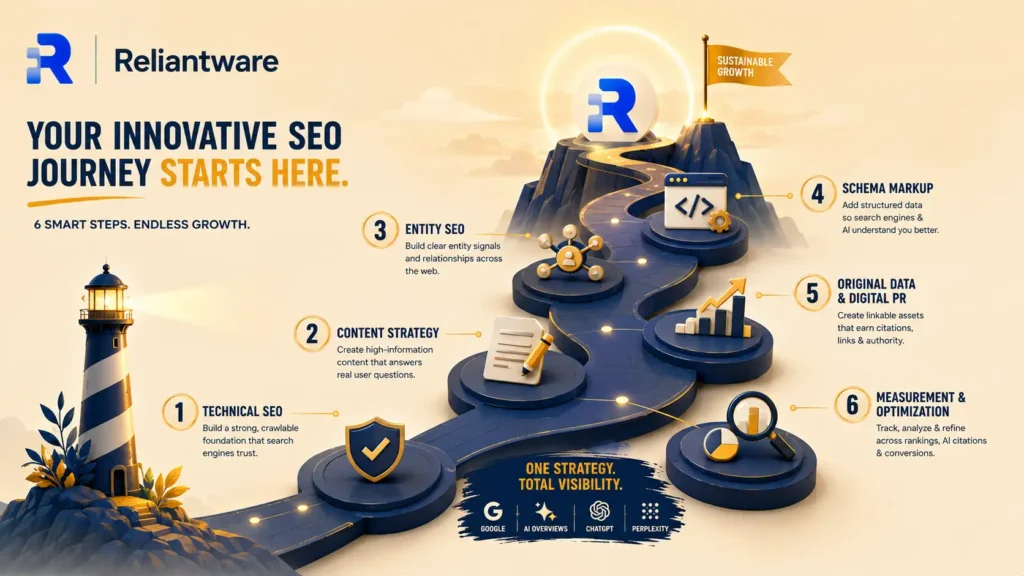
Start with the foundation, then layer in the newer tactics. Skipping steps rarely works well.
Step one, audit the technical basics. Confirm the site is crawlable, mobile friendly, and free of major speed issues. This takes days, not months, but nothing else works without it.
Step two, structure existing content for extraction. Rewrite key pages so every section opens with a direct answer and stands alone as a complete thought. This is usually a two to four week project depending on site size.
Step three, build entity consistency. Audit every place your business name and description appear online and align them. Directories, social profiles, the website itself.
Step four, add schema markup. Organization, Author, and FAQPage schema across key pages. A focused implementation project, typically a few weeks for a mid sized site.
Step five, create one genuine data asset. A single piece of original research or a first hand insight beats a dozen generic articles. Build this before scaling content volume.
Step six, set up measurement. Track rankings, traffic, AI citation frequency, and conversions together from the start, not as an afterthought six months in.
The honest truth is this whole sequence takes real time. Most businesses see meaningful movement in three to six months, and full topical authority can take longer depending on how competitive the space is. Anyone promising instant AI visibility isn’t being straight with you.
Conclusion
Innovative SEO is not a trend to chase or a replacement for the fundamentals. It is what gets built once the fundamentals are solid: a business that shows up accurately and credibly everywhere a potential customer might search, whether that search happens in Google, inside ChatGPT, or somewhere else entirely. Get the foundation right, build entity clarity and topical authority on top of it, and measure the results honestly.
That combination is what separates businesses that show up in AI generated answers from businesses that never get mentioned at all. Get a free audit at Reliantware and find out exactly where your business stands today.
FAQs
Is SEO still worth it in 2026?
Yes. Search behavior is shifting toward AI tools, but organic visibility across Google and AI Overviews still drives free, compounding traffic. The channels are expanding, not disappearing.
Can a beginner do SEO?
Yes, the fundamentals like keyword research and on page basics are learnable. Advanced work like entity SEO and GEO usually benefits from experienced guidance, which is where an agency like Reliantware fits in.
Can ChatGPT do SEO?
ChatGPT can help with research, outlines, and analysis, but it cannot execute technical fixes, earn backlinks, or replace strategic judgment. It works best as a tool alongside human expertise.
How much does it cost to hire someone to do SEO?
Costs vary widely by scope and market, from a few hundred to several thousand dollars monthly. Reliantware offers a free audit to give businesses a clear starting estimate.
Will SEO be replaced by AI?
Unlikely. AI is changing how people search, not eliminating the need for visibility. Businesses still need to be found and understood, whether that’s on Google or inside an AI answer.
What is a SEO salary?
SEO salaries vary by role and experience, typically ranging from entry level specialist pay to senior strategist compensation well above that. Location and agency versus in house also shift the range significantly.
What is replacing SEO?
Nothing is replacing SEO outright. It’s evolving to include AI search optimization alongside traditional ranking factors, expanding the discipline rather than ending it.
Is SEO a high income skill?
It can be, particularly for specialists who combine technical skill with strategy and measurable results. Freelancers and agency professionals with a strong track record often command strong rates.
Is it hard to get a job in SEO?
Entry level roles are competitive but accessible with demonstrated skills and a portfolio. Standing out usually means showing real results, not just certifications.
Losing Leads to AI Search Costs You $4,000+/Month. Fixing It Costs $0 in Ads.
Your customers ask ChatGPT and Google which company to hire. Show up there, and they call you.
Free.
Claim your Growth Plan now. No obligation