Table of Contents
How to Select Best Restaurant Franchise Marketing Agency in 2026
Quick Answer
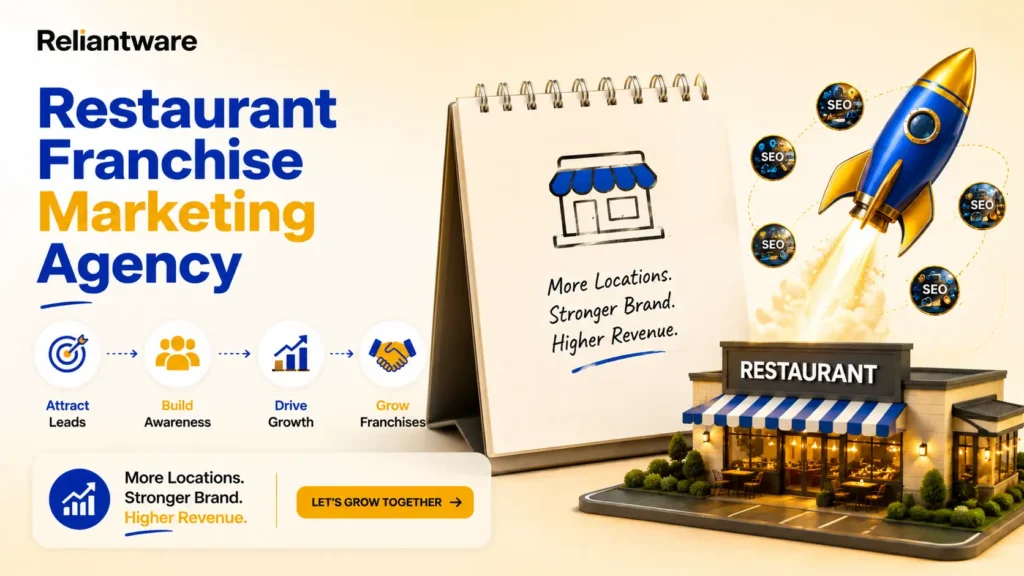
A restaurant franchise marketing agency manages marketing across every location, including local SEO, geofenced advertising, and franchisee lead generation. Before hiring one, check their multi-location SEO track record, how they report the co-op fund, and whether they track Cost Per Cover instead of impressions. Retainers typically run $1,500 to $3,000 or more, with ads showing results within weeks and SEO taking months to compound.
Reliantware handles this entire structure for restaurant franchises, combining local SEO, Google Business Profile management, and AI search visibility under one team.
Key Takeaways
- A restaurant franchise marketing agency manages marketing for multiple locations at once, not a single restaurant.
- Franchise marketing serves two audiences: current customers and prospective franchisees.
- Geofenced advertising within a 3 to 5 kilometer radius per location outperforms one national campaign.
- The franchisee marketing co-op fund is typically a percentage of gross sales pooled for centralized marketing.
- Cost Per Cover and Cost Per Lead are the primary KPIs, not impressions or likes.
- Monthly retainers for franchise marketing typically range from $1,500 to $3,000 or more.
- Local SEO for franchises requires managing Google Business Profiles across every location.
- AI search optimization helps franchise locations appear when customers ask AI assistants for recommendations.
- Local SEO improvement typically takes several months, while paid advertising can show results within weeks.
What Does a Restaurant Franchise Marketing Agency Actually Do
A restaurant franchise marketing agency runs coordinated marketing across every location in a franchise system while customizing execution to each local market. Core services typically include local SEO at scale, geofenced paid advertising, franchisee lead generation, and reputation management across every branch. The agency essentially becomes the marketing department for a system that a single in-house team usually cannot manage alone once a brand crosses five or six locations.
Take geofenced advertising as an example. Instead of running one blanket campaign for the whole brand, a specialized agency builds a tight three to five kilometer radius targeting each individual store. And they layer daypart timing on top of that. Lunch specials get pushed to nearby office workers around 11:30am. Family dinner offers go out closer to 6:00pm. That kind of precision only works when someone is managing dozens of these campaigns simultaneously, which is exactly the infrastructure gap most in-house teams run into.
The practical takeaway: if an agency cannot explain how they would structure geofenced, daypart specific campaigns for your specific number of locations, they are likely applying single restaurant thinking to a franchise problem.
How Franchise Marketing Differs From a Single Restaurant
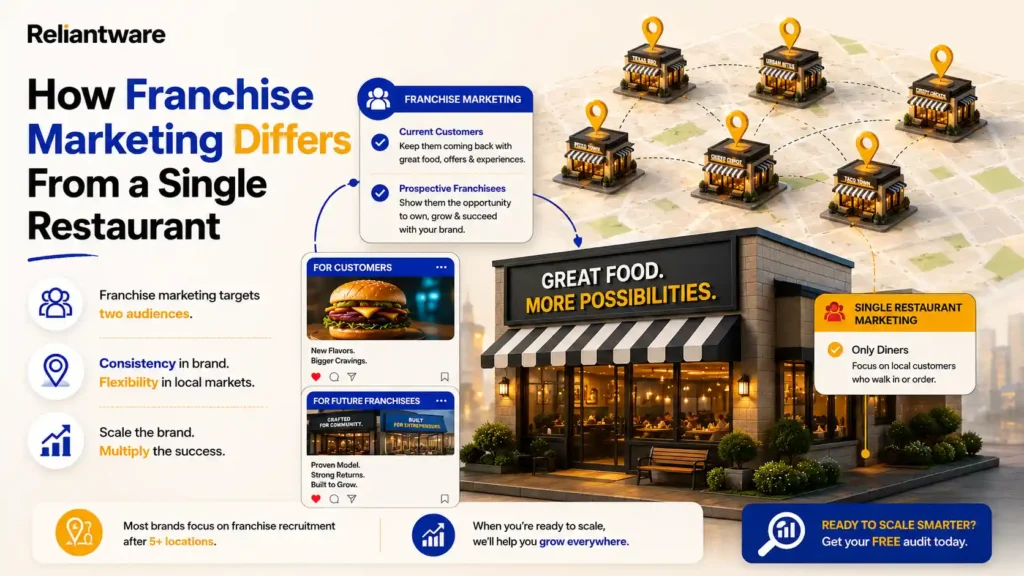
Franchise marketing has to serve two audiences at once: current customers and prospective franchisees, while a single restaurant only markets to diners. This dual mandate changes almost everything about strategy. Corporate needs brand consistency across every location. Individual franchisees need enough local flexibility to compete in their specific neighborhood.
A common solution is running two distinct social media tracks. One account handles consumer facing content: food photography, promotions, seasonal menu pushes. A second track, often through the same team or a franchise recruitment landing page, showcases store build outs, franchisee success stories, and investment economics for people considering buying into the brand. Mixing these two audiences into one feed usually confuses both.
Keep in mind that not every franchise needs the same marketing strategy. If you have only three locations, you probably don’t need to focus on franchisee recruitment yet. That usually becomes important once your brand grows to around five or more locations and you’re actively looking to sell new franchise territories. At that stage, it’s worth adding franchise development to your overall marketing plan.
What to Look For When Choosing an Agency
Look for an agency that can answer specific budget and reporting questions immediately, not one that just lists services. Generic marketing agencies can run ads. What separates a genuine franchise specialist is how they think about allocation, attribution, and franchisee communication.
Questions to ask about budget allocation across locations
Ask directly: “How do you handle budget allocation across your top performing flagship locations versus your newer or underperforming regional branches?” A generalist agency will often give a vague answer about optimizing based on performance. A franchise specialist should describe an actual framework, something like protecting a baseline spend for every location while shifting incremental budget toward locations showing the strongest cost per lead.
Questions to ask about reporting and attribution
Ask: “How do you tie ad spend back to actual POS data or direct orders, not just impressions and clicks?” This single question filters out most generalist agencies fast. You want an agency talking about Cost Per Cover and direct revenue attribution, not follower counts.
For most brands under 10 locations, a single dedicated account contact working weekly is enough. Larger systems with 15 or more locations typically need a structured account team with regional breakdowns. In most cases, if an agency proposes the exact same reporting structure regardless of your location count, they have not actually built for franchise scale.
How the Franchisee Marketing Co-op Fund Works
A franchisee marketing co-op fund is a shared pool, typically funded by a small percentage of each location’s gross sales, used to pay for centralized brand marketing. This structure lets a franchise system run bigger, more coordinated campaigns than any single franchisee could afford alone. But it only works if franchisees trust how the money gets spent.
The mechanism that builds that trust is transparent, ongoing reporting. A live dashboard that shows both the franchisor and individual franchisees how the co-op fund is being allocated, which campaigns are running, and what results each location is seeing removes the black box feeling that causes franchisee pushback. Franchisees who can see their contribution translating into measurable local traffic are far more likely to support fee increases down the line.
Skipping this reporting layer is one of the fastest ways to create friction between corporate and franchisees, regardless of how good the actual marketing results are.
Realistic KPIs and Costs to Expect
Expect monthly retainers to start around $1,500 to $3,000+, depending on how many locations you have and the level of support you need. Rather than focusing on vanity metrics like impressions or likes, pay attention to numbers that directly impact your business. Metrics such as Cost Per Cover and Cost Per Lead show whether your marketing is actually bringing in diners and generating new business. Impressions and likes can indicate visibility, but they don’t necessarily translate into revenue.
Cost Per Cover measures how much you spent in marketing to generate one paying table or order. Cost Per Lead measures the same thing for franchisee recruitment campaigns, how much you spent to generate one qualified franchisee inquiry. ROAS, return on ad spend, ties the two together at a campaign level.
For most multi location brands, monthly retainers scale with the number of locations and the depth of service, from around $1,500 for smaller regional chains needing local SEO and reputation management, up toward $3,000 or more for larger systems needing full geofenced advertising, franchisee lead gen, and content production together. Project based fees are more common for one time work like a franchise recruitment website build or a rebrand.
Be careful of any agency that promises guaranteed new customers in a short amount of time. While paid ads can bring quicker results, local SEO usually takes a few months to build momentum. The best agencies set realistic expectations and focus on steady, long-term growth instead of making promises they can’t guarantee.
Local SEO and AI Search Visibility Across Every Location
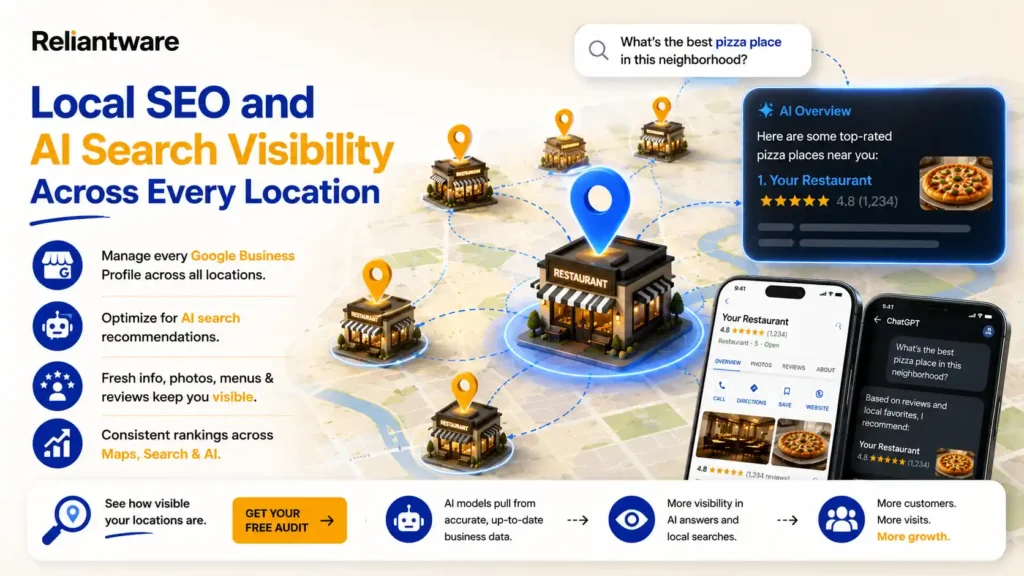
Local SEO for a franchise means managing dozens of Google Business Profiles simultaneously, while AI search optimization ensures your locations show up when customers ask AI assistants for recommendations. Diners increasingly ask tools like ChatGPT or Google’s AI Overviews questions like “what’s the best pizza place in this neighborhood” instead of typing a traditional search. That shift means franchise SEO now has to account for two audiences: search engine crawlers and AI models pulling from structured, current data.
Every location needs fresh photos, correct hours, an updated localized menu, and active review generation to feed both systems accurately. A location with stale information or a thin review profile becomes invisible in both classic search and AI generated recommendations, no matter how strong the paid advertising is.
This is where working with a team that understands both classic ranking factors and how AI tools surface local businesses becomes the differentiator. Reliantware works specifically with restaurants on exactly this combination, helping franchise locations show up consistently across Google Maps, organic search, and AI powered discovery. If your locations are ranking inconsistently across your footprint, that gap is usually fixable with a focused local SEO and AI visibility audit.Get a free audit at Reliantware.
Common Mistakes Franchise Brands Make With Marketing
- Franchise brands repeatedly fall into the same traps when structuring their marketing, usually because they apply single restaurant thinking to a multi location system.
- Running one blanket national campaign instead of geofenced local campaigns. This wastes budget on markets that do not need the exposure while undeserving locations that do.
- Treating the co-op fund as a black box with no franchisee visibility. This erodes trust and creates resistance to future fee increases, regardless of actual performance.
- Many agencies focus on impressions and likes because they look good in reports. But franchisees care about results. Track Cost Per Cover and qualified leads to see if your marketing is actually bringing in more customers.
- Ignoring AI search visibility while over indexing on traditional Google rankings. Ranking well on classic search no longer guarantees visibility when a growing share of diners are asking AI assistants directly.
Conclusion
Franchise marketing is a system, not a scaled up version of single restaurant marketing. The agencies that actually deliver treat every location’s local relevance and every franchisee’s trust in the shared fund as part of that same system, not as separate problems. When you are evaluating a restaurant franchise marketing agency, the fastest way to separate specialists from generalists is asking how they handle budget allocation, attribution, and franchisee reporting specifically, not just what services are on their website.
Get a free audit at Reliantware and see how Reliantware helps restaurants dominate local search.
FAQs
What is a restaurant franchise marketing agency?
A firm that manages marketing across every location in a franchise system, handling local SEO, ads, franchisee leads, and reputation management.
Why should a restaurant franchise hire a specialized marketing agency?
Franchise marketing needs multi-location SEO, geofenced ads, and co-op fund reporting that generalist agencies typically lack.
What services does a restaurant franchise marketing agency offer?
Local SEO, Google Business Profile management, geofenced advertising, franchisee lead generation, reputation management, and content marketing.
How does franchise marketing differ from traditional restaurant marketing?
It serves two audiences, customers and prospective franchisees, balancing brand consistency with local relevance per location.
Is local SEO available for restaurant franchises?
Yes. It covers Google Business Profile optimization, review management, and local citations for every location.
Can Google Business Profiles be optimized for every franchise location?
Yes. Agencies manage hours, photos, menus, and reviews at scale across every location.
How long does it take to see results from franchise marketing?
Paid ads show results within weeks. Local SEO typically takes several months to compound.
How much does restaurant franchise marketing cost?
Monthly retainers typically run $1,500 to $3,000 or more, depending on location count and scope.
How is brand consistency maintained across multiple franchise locations?
Centralized brand guidelines and approved asset libraries let each location run local campaigns without going off brand.
Does franchise marketing support both franchisors and franchisees?
Yes. Corporate campaigns run alongside local marketing support for individual franchisees at each location.
Empty Tables Cost You $4,000+/Month. Filling Them Costs $0 in Ads.
Get Your Free Revenue Roadmap
Hungry diners search Google every night. Show up there, and they come to you.
Free.
Claim your Roadmap now. No obligation