Table of Contents
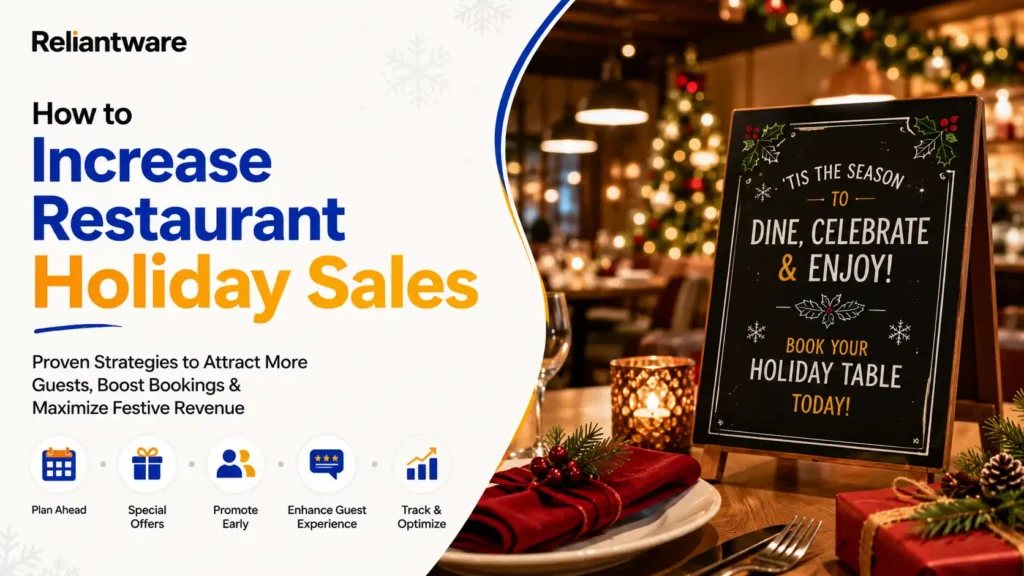
How to Increase Restaurant Holiday Sales in 2026
Quick Answer
To Increase Restaurant Holiday Sales, focus on five moves. Prioritize private events and catering packages first, since they carry the highest margin of the season. Launch a gift card bonus early for immediate cash flow, and make it redeemable in January and February to bring guests back afterward. Add family-style bundles and pre-order takeout to raise average order value for guests celebrating at home.
Then update your Google Business Profile and website, since visibility now decides bookings as much as your menu does, and this is exactly where Reliantware helps restaurants get discovered on Google and AI search. Start all of this in September and October, not December, then track revenue and bookings once the season ends to sharpen next year’s plan.
Key Takeaways
- Start corporate outreach and private event promotion in September and October, before competitors book the best dates.
- Tiered catering packages (Silver, Gold, Platinum) carry the highest margin of the holiday season.
- Gift card bonus offers, restricted to a January through February redemption window, drive cash flow now and traffic back later.
- Family style bundles and pre order takeout raise average order value without adding kitchen complexity.
- An outdated Google Business Profile costs bookings before a guest ever sees the dining room.
- Holiday diners now search across Google and AI tools, not just traditional search engines.
- Track revenue, redemption rates, and bookings after the season to improve next year’s plan.
Start Your Holiday Marketing Timeline Early
Restaurants should begin holiday marketing in September and October, not December. Corporate holiday parties get booked months ahead. Family reservations follow a few weeks behind. Treating both audiences the same wastes your best booking window.
A restaurant that waited until late November to promote a December private events calendar found half their prime Friday and Saturday slots already gone to competitors who called corporate clients back in September. That is a real cost, not a hypothetical one.
What to Do in September and October
Update your private events page and holiday menu preview. Reach out directly to every corporate client who booked a party last year, before they start shopping around. This single step recovers repeat business that would otherwise go to whoever calls first.
What to Do in November and December
Shift to public facing promotion. Launch your gift card bonus offers and open pre orders for takeout holiday bundles. By December, your marketing should pivot again, toward last minute gift card buyers and New Year’s Eve reservations, while your kitchen focuses on execution instead of promotion.
Maximize Private Events and Corporate Catering
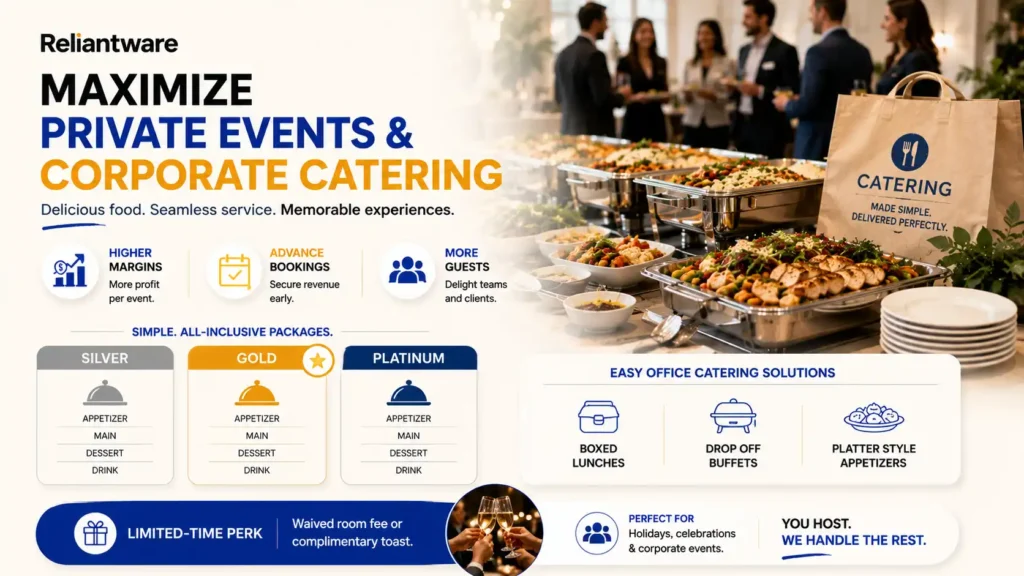
Private events and corporate catering generate the highest margin dollars of the season. Group bookings mean larger checks, less table turnover pressure, and often prepaid revenue secured weeks in advance.
Create three simple catering packages, such as Silver, Gold, and Platinum, with appetizers, mains, dessert, and non-alcoholic drinks included at a fixed price per person. This makes booking easier by removing the hassle of building a menu from scratch. To encourage early bookings, offer a limited-time perk like a waived room fee or a complimentary toast instead of discounting your food.
For smaller local businesses, build a simpler office catering menu: boxed lunches, drop off buffets, and platter style appetizers. These orders take less coordination and still add meaningful volume.
This tactic works best for restaurants with private dining space or the floor flexibility to host larger parties. A twelve seat counter service spot will not see the same lift from tiered event packages, and forcing the strategy there usually creates more operational strain than revenue.
Turn Gift Cards Into Immediate Cash Flow
Gift card promotions generate cash in November and December while also pulling guests back during the slow months that follow. The mechanism is simple: offer a bonus card with every purchase, something like a complimentary $10 or $20 card for every $50 or $100 spent.
The redemption window matters as much as the offer itself. Restrict bonus cards to a window like January 1 through February 28. That restriction is not arbitrary. It deliberately drives traffic back into your slowest sales period, converting a holiday transaction into a first quarter reservation.
Display gift cards where impulse purchases happen, at the host stand, on table tents, near checkout. Most gift card purchases are not planned in advance. They happen because someone saw the offer at the right moment.
Build Holiday Menus and Bundles That Raise Average Order Value
A limited time holiday menu gives guests a reason to visit now instead of waiting, and it raises what they spend per visit. Seasonal ingredients support dishes you cannot reasonably serve year round, which is exactly what makes them feel special. This kind of seasonal demand is well documented too, the National Restaurant Association regularly tracks how limited time and seasonal offerings drive higher guest spend across the industry.
Family style bundles work particularly well during the holidays because groups are already larger. Package a complete meal, a whole roasted protein, several sides, and a dessert, sized for four, six, or ten people. This simplifies ordering for the guest and increases the average check without adding menu complexity for your kitchen.
For guests who want to celebrate at home, build a pre order takeout bundle with a strict cutoff, five to seven days before Thanksgiving, Christmas Eve, or New Year’s Eve. That lead time lets your kitchen prep with precision instead of guessing at volume, which cuts food waste and protects ticket times on your busiest nights.
Make Your Restaurant Visible Where Holiday Diners Are Searching
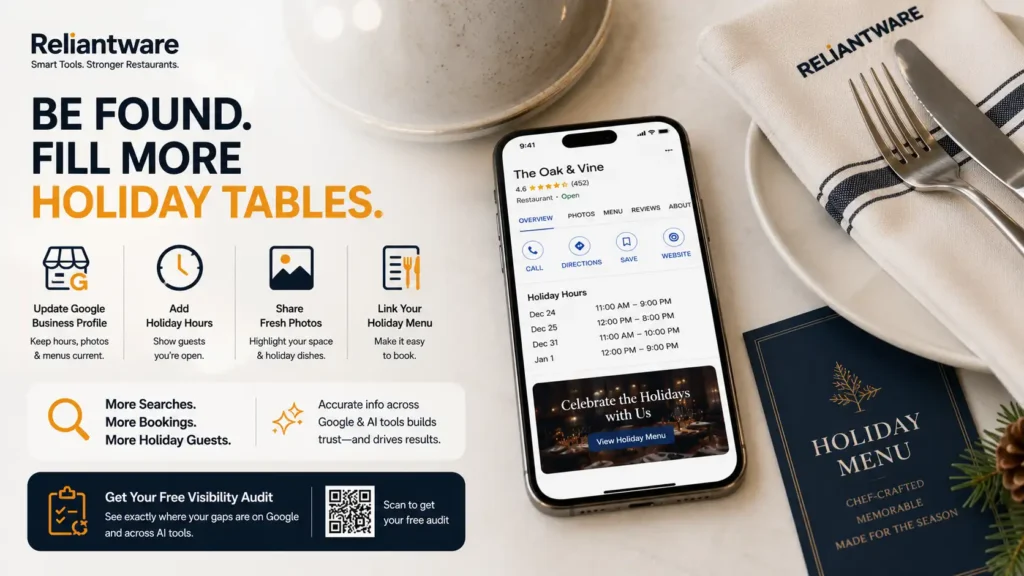
Holiday diners increasingly search using phrases like best Christmas dinner near me or restaurant holiday hours, and that search now happens across Google and AI tools, not just search engines alone. If your Google Business Profile is outdated or your website does not mention holiday hours and menus, you lose that visibility before a guest ever sees your dining room.
Update your Google Business Profile with current holiday hours, fresh photos, and a direct link to your holiday menu. Make sure your website reflects the same information. Guests decide where to eat based on what they find in the first few seconds of a search, and an outdated profile reads as a closed or inactive business, even if you are fully open and fully staffed.
This is where most restaurants stop optimizing, treating their online presence as a static listing instead of an active marketing channel. Restaurants that fix this typically see more calls, more bookings, and more holiday tables filled, simply because guests can actually find them when it counts. Get a free audit at Reliantware and see exactly where your visibility gaps are, on Google and across the AI tools diners now use to decide where to book. If your holiday visibility strategy stops at a Google Business Profile update, you are only solving half the problem.
Before making a reservation, many diners now check both search engines and AI assistants to find the best restaurants. Keeping your online listings accurate and up to date helps your restaurant appear in those searches and gives customers more confidence to choose you.
Private Events vs Off-Premise Holiday Sales
|
Factor |
Private Events / Catering |
Off-Premise / Takeout |
|
Setup effort |
High, requires coordination |
Moderate, requires prep planning |
|
Margin |
Highest per booking |
Solid, but lower per order |
|
Lead time needed |
Weeks to months |
Days to a week |
|
Staffing impact |
Concentrated on event day |
Spread across prep days |
Extend Gift Cards and Loyalty Into January
The restaurants that benefit most from the holidays are the ones that use it to set up a stronger January and February, not just a stronger December. Bounce back gift card windows do part of this work automatically. Loyalty rewards do the rest.
Offer double loyalty points during the holiday season to encourage sign ups while intent is high. Then follow up in January with a targeted reminder to redeem bonus gift cards or loyalty rewards, which reactivates guests during your lowest volume months instead of losing them until the next holiday season.
Which Holiday Tactics Fit Your Restaurant
Not every tactic applies equally to every restaurant. Use this framework to prioritize.
If you have private dining space or banquet capacity, prioritize tiered event packages and corporate outreach first. That is where the margin is.
If you are a smaller or quick service concept without event space, prioritize gift card promotions, takeout bundles, and local search visibility instead. These require less physical capacity and still meaningfully lift revenue.
If your kitchen is already at capacity during peak service, avoid adding complex, minute cooked holiday menu items. Choose high margin dishes that are fast to plate instead, since slow tickets during your highest volume nights cost more than they earn.
Common Mistakes That Cost Restaurants Holiday Revenue
Restaurants lose holiday revenue in predictable ways.
Waiting until December to start promoting. By then, corporate clients have already booked elsewhere and family reservations are filling competitor calendars.
Treating gift cards as a side offer instead of a cash flow strategy. Without a clear bonus structure and redemption window, gift cards do not drive the January bounce back they are capable of.
Overcomplicating the holiday menu. Elaborate, slow cook dishes look impressive but destroy ticket times exactly when your kitchen can least afford it.
Focusing only on social media while ignoring search visibility. Decor photos and festive posts build goodwill, but they do not reach the diner actively searching for where to eat tonight.
Skipping the redemption window on bonus gift cards. Without a set window like January through February, bonus cards get used whenever, and you lose the deliberate slow season traffic boost they are designed to create.
Conclusion
Increasing restaurant holiday sales comes down to combining three things most competitors treat separately: high margin private events, a deliberate gift card strategy, and genuine visibility where diners are actually searching. Start your outreach in September, not December. Price your catering tiers with intention. And make sure your restaurant is easy to find, on Google and beyond, when someone is deciding where to spend their holiday. See how Reliantware helps restaurants dominate local search, Get a free audit at Reliantware today!
FAQs
How to increase restaurant sales in winter?
Push comfort food specials, off-premise sales, and loyalty reactivation to offset lower foot traffic.
How to increase sales during Christmas?
Run a limited-time menu, gift card bonus offers, and pre-order takeout with a set cutoff date.
What are the two main ways to increase sales in your restaurant?
Get more customers, or increase how much each customer spends per visit.
What sells most during Christmas?
Gift cards, family style bundles, festive desserts, and seasonal cocktails.
What are the 5 sales techniques?
Common techniques include upselling, cross-selling, suggestive selling, creating urgency with limited-time offers, and building rapport with guests to encourage repeat visits.
What are the 5 C's of sales?
A commonly cited version includes Customer, Company, Competitors, Collaborators, and Climate, referring to the factors a sales strategy needs to account for.
What is the 30/30/30 rule for restaurants?
A budgeting guideline: 30% of revenue to food costs, 30% to labor, and 30% to overhead, leaving 10% profit.
What is the 2 2 2 rule in sales?
A follow-up framework: contact prospects at 2 days, 2 weeks, and 2 months after initial contact.
Empty Tables Cost You $4,000+/Month. Filling Them Costs $0 in Ads.
Hungry diners search Google every night. Show up there, and they come to you.
Free.
Claim your Roadmap now. No obligation