Table of Contents
How to Increase Restaurant Sales in 2026 | Without Paid Ads
Quick Answer
How to increase restaurant sales comes down to three levers: get more customers through the door, increase what each visit earns, and bring existing customers back without a discount. Fix your Google Business Profile first so new customers can find you on Google and AI tools like ChatGPT.
Train staff to make specific upsell suggestions instead of asking “anything else?” Redesign your menu so your highest margin dishes get seen before decision fatigue sets in. Build a simple loyalty and email system that turns one visit into repeat revenue. Every other tactic builds on these four.
The biggest mistake most restaurant owners make is pulling the wrong lever for the wrong problem. A full restaurant with flat revenue does not need more advertising, it needs better upselling and stronger retention.
Key Takeaways
- Diagnose first. Traffic, average order value, or retention. Fix the right problem or every tactic underperforms.
- Google Business Profile. Complete every section, 20+ photos, respond to every review. Incomplete profiles lose customers daily.
- Review recency wins. 40 fresh reviews beat 400 old ones. Build a system, not a habit.
- AI search is wide open. ChatGPT recommends restaurants above 4.3 stars. Most restaurants are invisible here. Your competitors probably are too.
- Upsell specifically. One named recommendation per course lifts average check 10 to 30 percent. Zero new customers needed.
- Menu placement matters. Highest margin dish top right corner. Drop the dollar sign. Descriptive language earns more.
- Retention over acquisition. Keeping a customer costs 5x less than finding a new one. Most restaurants ignore this completely.
- Structured offers, not discounts. Themed midweek night or office lunch fills slow periods. Blanket happy hours barely move anyone.
- Delivery apps for discovery only. Convert every app order to direct with a card in every bag. Keep the 15 to 30 percent commission.
- Track three numbers. Cover count, average check, visit frequency. The weakest one tells you exactly where to focus next.
Find Your Real Revenue Bottleneck First
What is actually stopping your restaurant from earning more? Every restaurant sales problem falls into one of three buckets, and pulling the wrong lever wastes both money and time.
Traffic problem: Empty tables during peak hours. Low reservation volume. Few new reviews coming in. Weak visibility on Google Maps for your cuisine and area. A restaurant running at 40 percent capacity on weeknights has a traffic problem. Training servers to upsell dessert will not fill those chairs.
Average order value problem: Your restaurant is busy but revenue is flat. Guests order a main and skip starters, drinks, and dessert. The staff ask “anything else?” instead of making specific recommendations. You are leaving money on every table, every single shift.
Retention problem: Strong first-time traffic that never returns. No email list. No loyalty mechanism. No way to reach past customers directly. You are filling the bucket from the top while it leaks from the bottom.
Once you know which bucket you are in, every tactic below stops being a random list and becomes a plan. Start with the section that matches your bottleneck. Come back to the others once the primary problem is solved.
How to Get More Customers in Your Restaurant
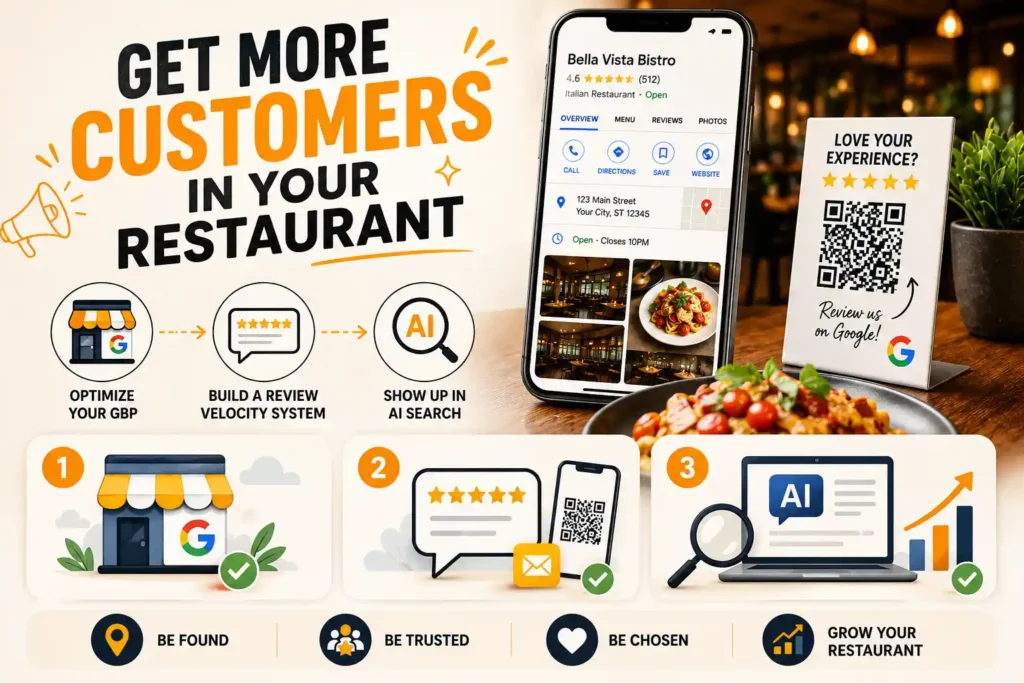
How do restaurants increase customer count without paid advertising? Fix your Google Business Profile first, build a review velocity system second, and show up in AI search third. These three steps drive more new customers than any paid campaign at any budget level.
Google Business Profile is where customer acquisition starts. When someone searches “best restaurant near me” or “Italian restaurant open now,” Google Maps and the local 3-Pack decide who gets the click. A profile with outdated hours, blurry photos, or no recent reviews reads as neglect. Neglect costs bookings before a single customer ever sees your menu.
A fully optimized GBP includes complete and accurate hours updated for every holiday, a full menu uploaded directly inside the profile, at least 20 real photos covering food, interior, exterior, and staff, weekly Google Posts with current offers or events, and a response to every review. Restaurants that complete every section of their GBP get 70% more engagement on Google than those that do not.
NAP consistency suppresses rankings silently. Your Name, Address, and Phone number must be identical across every platform: Google, Yelp, TripAdvisor, Facebook, Apple Maps, and local directories. A small discrepancy like “St.” on one platform and “Street” on another sends conflicting signals to Google’s algorithm and quietly suppresses your local rankings. Most restaurant owners have no idea this is happening.
Review recency beats review volume. A restaurant with 40 reviews posted in the last 60 days typically outranks one with 400 reviews accumulated over five years. Recency signals that your reputation reflects what is happening now, not what happened three years ago. A burst of reviews in January means nothing by September if nothing fresh has come in since.
Build a system, not a habit. Train front-of-house staff to make the ask a natural part of ending a positive meal. Put a QR code linking directly to your Google review page on every table, every receipt, and every takeout bag. Set up an email follow-up timed to arrive 24 hours after a reservation. The goal is a consistent monthly stream, not an occasional push.
How to increase foot traffic during slow periods. Dead hours are a positioning problem, not a discount problem. Monday through Wednesday evenings and the 2 to 5 PM window are the highest-opportunity periods most restaurants leave completely unaddressed. Your competitors are not targeting these windows either, which means the competition is far thinner than it looks on a Friday night.
Three plays that work for most restaurants. The express office lunch targets corporate offices and coworking spaces within a 10-minute walk. A fixed-price, guaranteed-time lunch turns nearby workers into weekly regulars because they need speed, not variety. The themed midweek night gives people a specific reason to come in on a night they otherwise would not. Quiz night, live acoustic music, a rotating guest cuisine. A one-off event builds buzz. A weekly event builds habit. The off-peak bundle creates a high-margin, time-specific offer available only between 2 and 5 PM. A main plus a premium drink, priced to feel like a deal without discounting your core menu.
Social media supports all of this but as a consideration channel, not a conversion channel. The decision to visit happens on Google or in an AI chat window. Social keeps you in the mental shortlist so that when someone finally searches, your name surfaces first.
How to Increase Restaurant Sales Per Visit
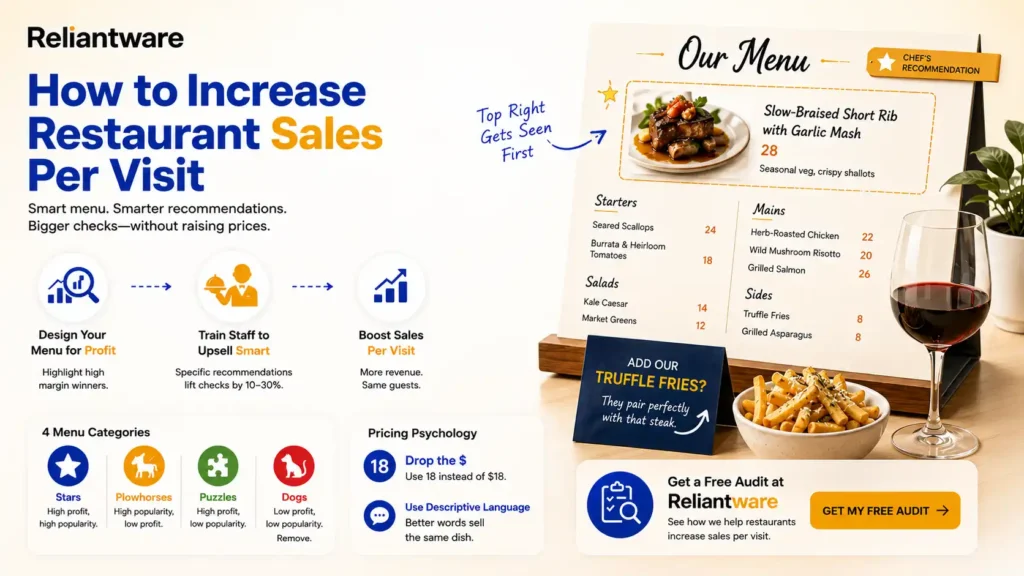
How do you get guests to spend more without raising prices? Train your staff to make specific named recommendations instead of generic prompts, and redesign your menu so your highest margin dishes get seen first.
Menu engineering increases revenue before a word is spoken. Every dish on your menu falls into one of four categories. Stars are high profit and high popularity. Plowhorses are popular but low margin. Puzzles are profitable but overlooked. Dogs are neither. Once sorted, you know exactly what to promote, adjust, or cut.
Diners scan a menu for under two minutes. Their eyes land on the top right corner first on a single-page menu. Place your highest margin dish there, not buried in the middle of a long list, and it goes in front of every guest before decision fatigue sets in.
Pricing psychology moves the needle too. Drop the currency symbol. Listing a dish as 18 instead of $18 reduces the mental friction of spending, according to research from Cornell’s hospitality program. Use descriptive language. A “slow-braised short rib with roasted garlic mash” consistently outsells “beef and potatoes” even when it is the same dish at the same price. The language earns the premium.
Upselling is the fastest revenue lever available. A well-trained server lifts average check size by 10 to 30 percent through confident, natural recommendations alone. No menu changes. No new customers. No advertising spend. That range comes from actual upsell training programs, not guesswork.
The difference is specificity. A server who says “Would you like to add our crispy truffle fries? They pair perfectly with that burger” converts far more often than one who asks “anything else?” Vague prompts get declined. Named, described suggestions get accepted.
Practical add-ons that work consistently: premium sides, extra protein, wine pairings matched to the dish, and dessert suggested before the check arrives rather than after. Train your team to make one specific recommendation per table, per course. That single habit applied consistently across every shift compounds into significant monthly revenue with zero increase in customer count.
How to Increase Restaurant Revenue Through AI Search
Are diners already asking AI tools where to eat, and is your restaurant showing up? Yes, and for most restaurants the answer to the second question is no.
Diners now ask ChatGPT, Gemini, and Perplexity questions like “best Italian restaurant near downtown” the same way they used to type it into Google. These tools answer with specific named recommendations pulled from sources they trust. If your restaurant’s information online is thin, inconsistent, or missing, you will not be mentioned. Your competitor with a complete profile and fresh reviews will be.
1 in 5 US consumers now use AI tools to research restaurants and bars, a number that puts AI nearly on par with Yelp for restaurant discovery. AI chatbot referrals to restaurant websites rose from 0.3% of traffic in 2024 to 2.5% in 2025. That number is expected to reach 10% by the end of 2026, making AI the second most common referral source for restaurant websites after Google.
The star rating threshold most restaurants do not know about. ChatGPT primarily recommends restaurants averaging 4.3 stars or higher. Perplexity recommends those at 4.1 or above. Gemini starts at 3.9. A restaurant sitting at a 4.0 average can still appear in Google search results but falls below the threshold AI platforms use to make recommendations. That gap between ranking and being recommended is where restaurants quietly lose customers they never knew they were losing.
What AI tools actually look at. When Yext analyzed 6.8 million citations from AI chatbot responses, foodservice results came from three main sources: third-party listing platforms like Yelp, Google Business, and DoorDash at 41.6% of citations, the restaurant’s own website at 39.8%, and reviews and social media at 13%. Your GBP, your Yelp profile, your website, and your reviews all feed the AI’s understanding of your restaurant. All four need to be strong and consistent.
Most restaurant marketing advice has not caught up to this yet. Winning this channel takes a different content strategy than a standard Google listing, one built around consistency, depth, and review velocity rather than keyword stuffing. This is the gap Reliantware closes for restaurant clients, building the local search presence that shows up on Google Maps and earns the AI recommendation simultaneously. See how Reliantware helps restaurants dominate local search.Get a free audit at reliantware.
How to Increase Restaurant Revenue Through Retention
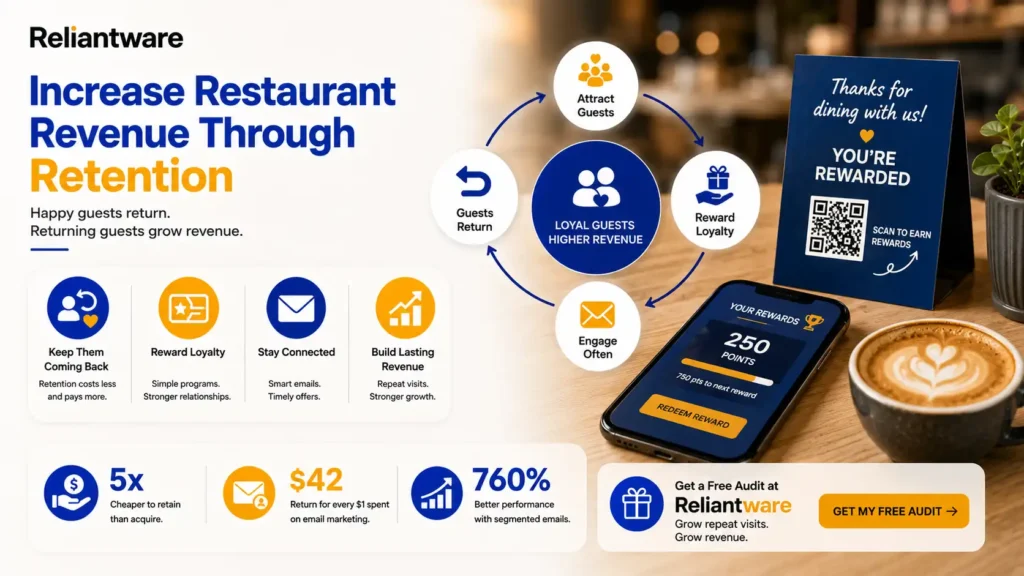
What is the most cost-effective way to grow restaurant revenue long term? Bring back the customers you already have.
Getting a new customer costs five times more than keeping an existing one. Most restaurants spend 90% of their marketing budget on acquisition and almost nothing on retention. That is the single most common reason restaurant revenue stays flat despite strong foot traffic and a full dining room on weekends.
Loyalty programs done right vs done wrong. Done right, a loyalty program increases repeat visits meaningfully. Done wrong, meaning complicated signup, confusing rewards, or a paper card that gets lost in a wallet, it just adds friction nobody uses.
Two models work well. Points-based systems suit high-frequency, lower-ticket restaurants like cafes where guests earn points per dollar and redeem for rewards. Visit-based systems, like a tenth meal free, suit full-service dining where the experience itself is already the draw.
One honest limitation: loyalty programs do not work for restaurants where most customers visit once or twice a year, like fine dining reserved for birthdays or anniversaries. For those, personalized email follow-ups and thoughtful offers outperform any points system every time.
Email and SMS sequences that compound restaurant revenue. The most effective triggers are birthday and anniversary messages with a genuine offer, win-back campaigns for customers who have not visited in 45 to 60 days, and new menu launch announcements sent to your existing list before you post on social media. Customers who feel they hear something first feel like insiders. That sense of being valued is a retention mechanic that costs almost nothing to run.
Restaurant email marketing returns $42 in revenue per dollar spent when segmented and behavior-based rather than generic blasts. Restaurants that segment their lists see 760% better campaign performance than those sending the same message to everyone.
Collect data at every touchpoint: Wi-Fi login, online reservations, QR code sign-ups. The list you build now compounds into predictable monthly revenue over time.
How to Increase Restaurant Delivery Sales
Should restaurants rely on third-party delivery apps or build direct ordering? Both, used for different jobs.
Delivery apps like DoorDash and Uber Eats put your menu in front of audiences you could not easily reach alone. But they take 15 to 30 percent per order in commission. They are excellent for discovery and terrible for profitability if that is where the relationship ends.
Convert delivery app customers to direct orders. Include a card in every bag with a small discount for ordering directly next time. Direct ordering keeps that commission, gives you the customer’s contact information, and lets you control the experience end to end.
| Factor | Third Party Apps | Direct Ordering |
| Commission cost | 15 to 30 percent per order | Near zero beyond payment processing |
| Customer data ownership | Platform keeps it | Restaurant keeps it |
| Discovery reach | High, new audience | Limited to existing awareness |
| Control over experience | Limited | Full control over upsells and branding |
Common Mistakes That Kill Restaurant Revenue
- Discounting instead of adding value. Cutting prices attracts bargain hunters who disappear the moment prices return to normal. It also trains regulars to wait for the next sale instead of paying full price.
- Running promotions with no way to measure results. Without tracking redemption or attributing sales to the offer, you cannot tell if a promotion worked or if you gave away margin for nothing.
- Chasing new customers while ignoring existing ones. Acquisition costs several times more than retention, yet most restaurants pour their entire budget into ads for strangers instead of nurturing guests already sitting in their dining room.
- Treating Google Business Profile as a one-time setup. It is a managed asset. A neglected profile loses ranking over time and costs you customers every week without you realizing it.
- Ignoring AI search entirely. 83% of restaurants are currently invisible in AI search. Every week without optimization is a week your competitor gets recommended and you do not.
Restaurant Improvement Plan: A Simple Sequence
Week one: Identify your real bottleneck. Fix your Google Business Profile completely. This costs nothing and benefits every path forward regardless of which problem you are solving.
First month: Tackle whichever lever matches your bottleneck directly. Menu engineering and upsell training for an average order value problem. Local visibility and AI search optimization for a traffic problem. A loyalty mechanism and email sequences for a retention problem.
Ongoing: Track three numbers weekly. Cover count, average check size, and visit frequency. Every tactic in restaurant marketing maps to one of these three. Fix the weakest one first before spreading the budget across all three simultaneously.
Conclusion
Increasing restaurant sales, revenue, and customer count is not about doing everything on this list at once. Diagnose your real bottleneck first. Then apply the specific tactics that address it directly.
Fix your Google Business Profile today. Build a review velocity system this week. Get into AI search before your competitors figure out it exists. Build the upsell habit that turns every busy shift into higher revenue. And build the retention system that turns one great meal into ten visits over the next year.
See how Reliantware helps restaurants dominate local search and AI visibility. Get a free audit at reliantware.
FAQs
How to increase sales at a restaurant?
Find your bottleneck first, traffic, average check, or retention. Fix your Google Business Profile, train staff to upsell by name, optimize for AI search, and build a loyalty system.
What are the 4 Ps of marketing for restaurants?
Product (food and dining experience), Price (menu pricing and value), Place (location, delivery, online visibility), and Promotion (ads, social, loyalty offers).
What are the 4 general ways to increase sales?
Get more customers, increase purchase frequency, raise average order value, and adjust prices without losing volume.
What are the 5 sales techniques?
Upselling, cross selling, consultative selling, social proof through reviews, and urgency or scarcity offers.
What are the 4 ways to increase revenue?
Sell more to existing customers, acquire new customers, raise prices, and increase visit frequency.
How to increase restaurant revenue without advertising?
Upsell training, a loyalty program, and a complete Google Business Profile. Upsell training gives the fastest lift since it needs zero new customers.
What are the main revenue drivers for a restaurant?
Cover count, average check size, and visit frequency. Fix your weakest one first.
How do I increase restaurant foot traffic?
Optimize your Google Business Profile, build a steady stream of fresh reviews, and create structured offers for slow periods like a midweek theme night.
What is the fastest way to increase restaurant sales?
Upsell training. One specific recommendation per course lifts average check by 10 to 30 percent, with no new customers needed.
How to improve restaurant business in a competitive market?
Win local search and AI recommendations first since most competitors ignore this. Stay above 4.3 stars, then retain guests through email and loyalty.
Empty Tables Cost You $4,000+/Month. Filling Them Costs $0 in Ads.
Get Your Free Revenue Roadmap
Hungry diners search Google every night. Show up there, and they come to you.
Free.
Claim your Roadmap now. No obligation