
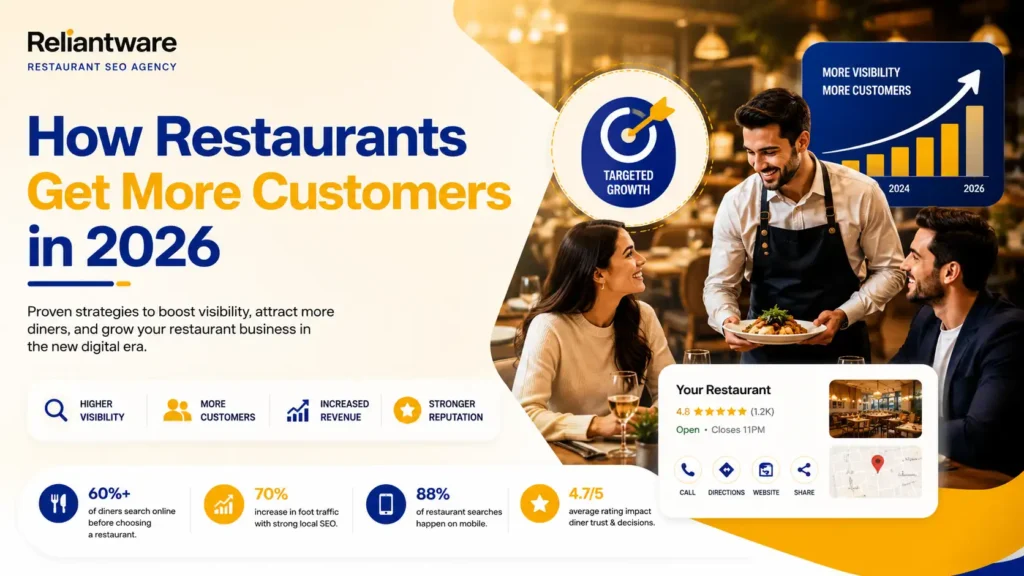
How restaurants get more customers is a question every owner asks. Most land on the same answers: social media posts, loyalty cards, maybe a discount on a slow Tuesday. And those things matter. But the actual decision where someone eats tonight happens in a search bar or an AI chat window, in about thirty seconds, while someone is already hungry.
Win that moment and you fill tables. Miss it and the restaurant down the street does.
Getting more customers in your restaurant comes down to a sequence, not a list of tactics. This guide explains what actually moves the needle, and names the one customer acquisition channel that most restaurants have not touched yet.
Quick Answer
Getting more restaurant customers starts with your Google Business Profile. Optimize it fully, build a steady stream of fresh reviews, and make sure your restaurant shows up when someone asks ChatGPT or Gemini where to eat tonight. Fill slow periods with structured offers, bring existing customers back through email and loyalty, and use social media to stay top of mind. The decision to visit happens in a search bar or an AI chat window. Win that moment and you fill tables.
Start Where Hungry People Actually Look
How do restaurants show up when someone nearby searches for a place to eat? The answer, for the vast majority of searches, is Google. Specifically, Google Maps and the local 3-Pack (the three businesses that appear at the top of any location-based search).
Getting into that 3-Pack starts with one thing: your Google Business Profile (GBP). Not a website. Not Instagram. Your GBP.
Here is what most restaurant owners get wrong. They set up the profile once, add the address and phone number, and move on. That is not optimization. That is the minimum viable listing, and it will not rank.
A fully optimized GBP includes complete and accurate hours (including holiday hours), a full menu uploaded directly inside the profile, at least 20 photos covering food, interior, exterior, and staff, weekly Google Posts with current offers or events, and responses to every review, positive or negative. Restaurants that complete every section of their GBP get 70% more engagement on Google than those that do not.
The NAP consistency problem. Your Name, Address, and Phone number need to be identical across every platform where your restaurant is listed: Google, Yelp, TripAdvisor, Facebook, Apple Maps, Zomato, and local directories. Even a small discrepancy, like “St.” on one platform and “Street” on another, sends conflicting signals to Google’s algorithm and suppresses your local rankings. Most restaurant owners have no idea this is hurting them.
Check every listing. Fix the inconsistencies.It is not exciting work, but it gives real results
The Review System That Actually Fills Tables
Why do reviews matter so much for getting more restaurant customers? Because 68% of diners say they have tried a new restaurant specifically because of positive online reviews. And because reviews are now the primary input for both Google Maps rankings and AI search recommendations.
Most restaurant owners know they need more reviews. Very few have a system for getting them.
Here is what the data actually shows, and this is the part no generic marketing article will tell you: review recency beats review volume. A restaurant that collected 400 reviews over five years may be outranked, on both Google and AI platforms, by a competitor with 40 reviews posted in the last 60 days. Recency is a confidence signal. It tells the algorithm that your restaurant’s reputation reflects what is happening now, not what happened in 2021.
The AI threshold. This matters even more once you understand how AI tools like ChatGPT and Gemini select restaurant recommendations. ChatGPT primarily recommends restaurants averaging 4.3 stars or higher. Perplexity recommends those at 4.1 or above. Gemini starts at 3.9. A restaurant sitting at a 4.0 average can still appear in Google search results but falls below the threshold these AI platforms use to recommend. That gap, between ranking and being recommended, is where a lot of restaurants are quietly losing customers they never knew they were losing.
How to build a review velocity system. Train front-of-house staff to make the ask a natural part of the end of a positive meal, not a scripted closing line. Put a QR code that links directly to your Google review page on every table, every receipt, and every takeout bag. Set up a short email follow-up for customers who book through your website or reservation system, timed to arrive 24 hours after their visit. The goal is a consistent stream of fresh reviews, not a burst campaign once a quarter.
Respond to every review. Positive or negative. A thoughtful response to a negative review is a public demonstration of how you run your business. Diners read those responses before they decide.
How to Get Your Restaurant Recommended by AI Search
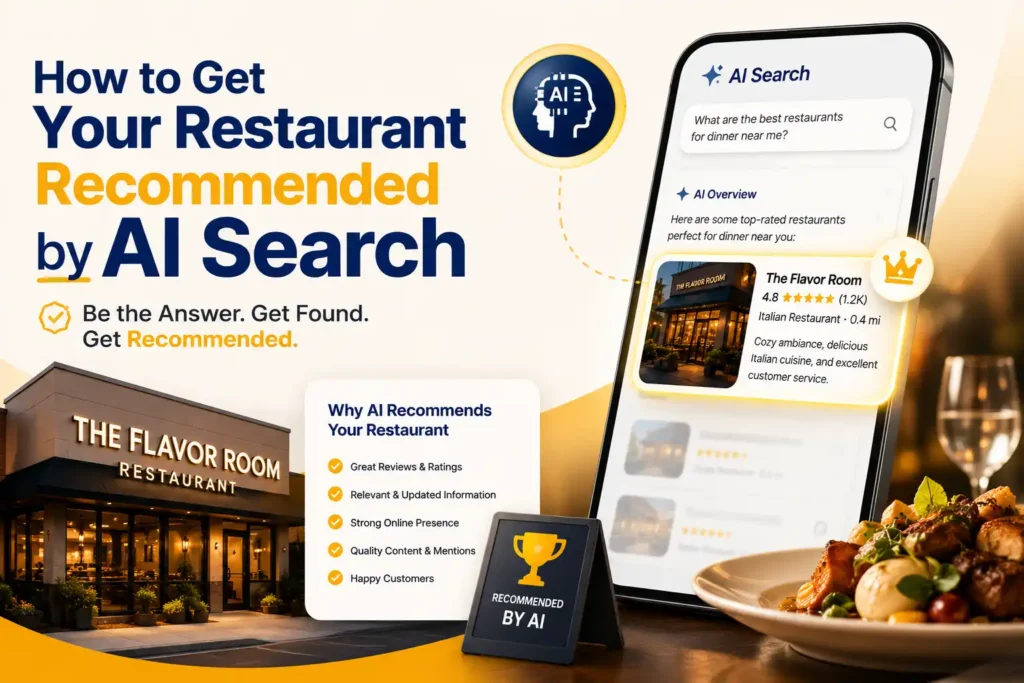
Can a restaurant show up in ChatGPT or Gemini results? Yes. And right now, most of your competitors have not figured this out yet.
1 in 5 U.S. consumers now use AI tools like ChatGPT to research restaurants and bars, a number that puts AI nearly on par with Yelp for restaurant discovery. AI chatbot referrals to restaurant websites rose from 0.3% of traffic in 2024 to 2.5% in 2025. The CEO of restaurant tech company Chowly expects that number to hit 10% by end of 2026, making AI the second most common referral source for restaurant sites after Google. That shift is happening now.
This is the gap. Most restaurant marketing advice covers Google SEO. Almost none of it covers what actually happens when someone asks ChatGPT “where should I eat in [city] tonight?”
What AI tools look at when recommending restaurants. When a Yext study analyzed 6.8 million citations from AI chatbot responses, foodservice results came from three main sources: third-party listing platforms like Yelp, Google Business, and DoorDash (41.6% of citations), the restaurant’s own website (39.8%), and reviews and social media (13%). That means your GBP, your Yelp profile, your own website, and your reviews are all feeding the AI’s understanding of your restaurant. All four need to be strong and consistent.
The two-game strategy. Google SEO and AI SEO are related but different games. Google ranks restaurants based on relevance, proximity, and signals like reviews and keyword-optimized content. AI tools go further. They look at the volume, recency, and descriptive quality of your reviews, the accuracy of your listings across platforms, and what your website actually says about the dining experience you offer.
Winning both games is not twice the work. The foundation is the same: a complete GBP, consistent NAP data, strong review velocity, and a restaurant website that clearly describes your cuisine, atmosphere, and what makes you worth visiting. Build that foundation and you compete in both channels simultaneously.
This is exactly the work Reliantware does for restaurant clients: building the local search presence that shows up on Google Maps and earns the AI recommendation. If you want to see where your restaurant stands right now, Get a free audit at Reliantware
Turn Slow Days Into a Revenue System
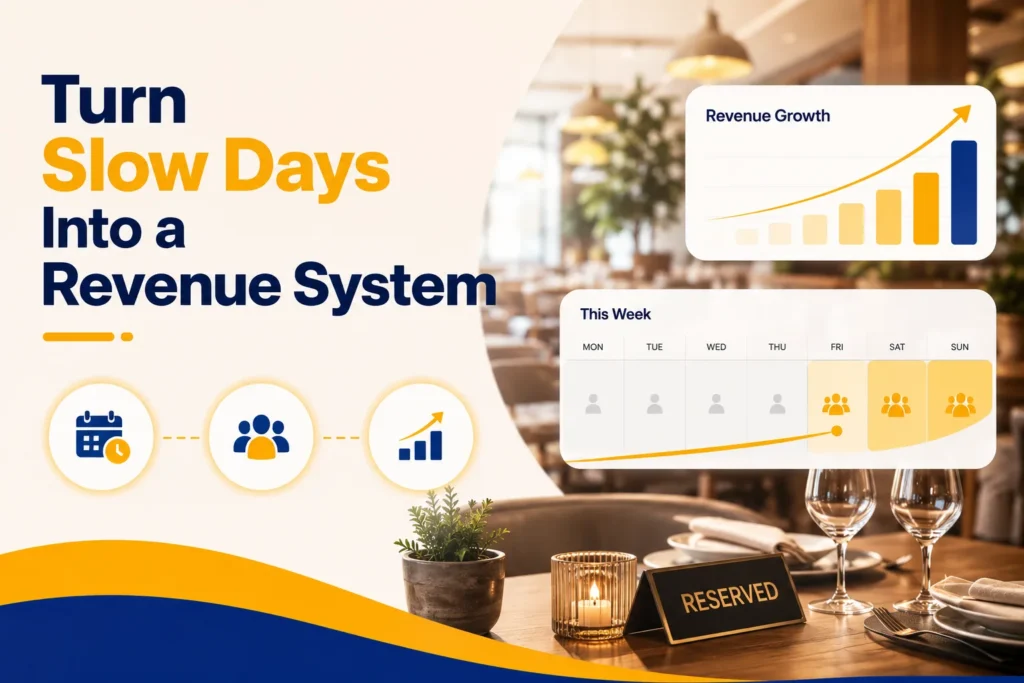
How do you fill tables during off-peak hours and slow weekdays? Most restaurants treat this as a discount problem. It is actually a positioning problem.
Monday through Wednesday evenings and the 2 to 5 PM window are the highest-opportunity periods most restaurant owners leave almost entirely unaddressed. Your competitors are not targeting these windows with structured offers either, which means the competition is much thinner than it looks on a Friday night.
Three dead zone plays that work for most restaurants:
The express office lunch. Identify the corporate offices, coworking spaces, and retail businesses within a 10-minute walk of your restaurant. Build a fixed-price, guaranteed-time lunch “in and out in 30 minutes, or the next one’s on us” and market it specifically to that corridor. Office workers need speed, not variety. Give them reliability and they become weekly regulars.
The themed midweek night. A recurring weekly event (quiz night, live acoustic music, a rotating guest cuisine, wine tasting) gives people a specific reason to come in on a night they otherwise would not. The key word is recurring. A one-off event builds buzz. A weekly event builds habit.
The off-peak bundle. Build a high-margin, time-specific bundle (a main plus a premium drink) available only between 2 and 5 PM. Price it to feel like a deal without discounting your core menu. Communicate it through your Google Posts, email list, and in-venue signage.
One honest limitation here: the midweek bundle and themed night approach works well for casual and neighborhood restaurants. For fine dining at higher price points, these tactics can feel inconsistent with the brand and need to be adapted carefully. A tasting menu preview or sommelier-led wine event may serve the same purpose without the discount association.
Build the Repeat Customer Machine
What is the most cost-effective way to get more restaurant customers? Bring back the ones you already have.
A repeat customer spends more per visit than a first-timer. They leave more reviews. They refer friends without being asked. And they cost a fraction of what it takes to acquire a brand-new customer through advertising or search. Most restaurants spend the majority of their marketing budget chasing new customers and almost nothing on keeping existing ones.
A digital loyalty program is not a nice-to-have anymore. Paper punch cards have one advantage: they feel tactile. But they give you zero data. A digital program tells you who your regulars are, what they order, how often they visit, and when they stop coming. That last signal is when you can win them back.
Email and SMS sequences that produce repeat visits. The most effective triggers are birthday and anniversary messages (with a genuine offer, not a vague “come celebrate with us”), win-back campaigns for customers who have not visited in 45 to 60 days, and new menu launch announcements to your existing list before you post on social media. Customers who feel they are hearing something first, before the general public, feel like insiders. That is a powerful retention mechanic.
Collect email and phone data at every touchpoint: Wi-Fi login, online reservations, QR code sign-ups. The list you build now is the asset that compounds over time.
Does Social Media Actually Bring Customers Through the Door?
The honest answer: yes, but not the way most restaurants use it.
Social media is a consideration channel. It is where someone who is vaguely aware of you becomes genuinely curious. It is not where they make the final decision. That decision happens on Google or in an AI search result. What social media does is keep you in the mental shortlist so that when someone finally searches for somewhere to eat, your name comes up.
Nearly half of consumers use social media to find new restaurants. But the mechanism is awareness, not conversion. Spending four hours a week on Instagram while neglecting your Google Business Profile is optimizing the wrong channel.
What actually works on social: high-quality food photography in natural light, short behind-the-scenes prep and plating videos, and content on TikTok that creates genuine curiosity. ASMR cooking, the story behind a dish, unexpected ingredients. Content that makes someone think “I need to go there” rather than just “that looks good.”
On influencer marketing: it works when the influencer’s audience overlaps with your actual geographic customer base. A micro-influencer with 8,000 local followers beats a food blogger with 50,000 followers mostly based in another city. Ask to see audience location data before you offer a complimentary meal.
Common Mistakes That Cost Restaurants the Most Customers
- Treating Google Business Profile as a one-time setup. It is a managed asset. Neglected profiles lose ranking over time.
- Asking for reviews without a system. Occasional asks produce occasional reviews. You need consistent volume and recency.
- Running paid ads before the foundation is in place. Ads drive traffic to your GBP and website. If those are thin or incomplete, you are paying for traffic that does not convert.
- Posting on social media for the algorithm instead of for the customer. Viral reach from a random city produces zero table bookings.
- Treating every day identically. No structured reason to come in on a Tuesday means customers default to the weekend, and you leave significant mid-week revenue uncaptured.
Conclusion
The restaurants that grow consistently are not doing everything at once. They follow a sequence: show up first when someone searches, earn the review that earns the next booking, get into the AI recommendation shortlist, and build the repeat customer system that turns one great meal into a lifetime of visits.
Most of your competitors are only playing the Google game. The AI game is wide open.
See how Reliantware helps restaurants dominate local search. Get a free audit at Reliantware
FAQs
How can a restaurant attract more customers?
Optimize your Google Business Profile, build a consistent review system, and make sure your restaurant appears in both Google Maps and AI search results like ChatGPT and Gemini. These three steps drive more new customers than any paid campaign.
What is the 30/30/30 rule for restaurants?
The 30/30/30 rule suggests spending 30% of revenue on food costs, 30% on labor, and 30% on overhead, leaving 10% as profit. It is a baseline benchmark, not a guarantee, and varies significantly by restaurant type and market.
What are the 4 P’s of marketing for restaurants?
Product (your food and experience), Price (positioning and perceived value), Place (location plus online visibility on Google and AI), and Promotion (how you reach new and returning customers). Most restaurants over-invest in promotion and under-invest in place.
What are the three C’s in a restaurant?
Consistency, Cleanliness, and Customer Service. These are the operational foundation that makes every marketing effort work. Great marketing brings people in once. The three C’s bring them back.
What are four ways to attract customers?
Show up in local search, generate fresh Google reviews consistently, run structured offers during slow periods, and build a repeat customer system through email and loyalty programs.
What are the 5 suggestive selling techniques for restaurants?
Recommend the most popular dish, suggest an upgrade or add-on, mention limited-time specials, pair a drink with the meal, and offer dessert before the check arrives. Each technique increases average spend per table.
What are the six strategies to attract customers?
Optimize local search presence, build review velocity, target off-peak periods with structured offers, run email and SMS campaigns, use social media for awareness, and get listed accurately across every directory AI tools pull from.
How to attract a younger crowd to a restaurant?
Short-form video content on TikTok and Instagram Reels, a visually strong menu with shareable dishes, fast Wi-Fi, and a seamless online ordering or reservation experience. Younger diners also check AI tools and social media before Google, so both channels need attention.
What can I say to attract customers?
Lead with specificity, not hype. “Best wood-fired pizza in [neighborhood], open late” beats “great food and amazing atmosphere” every time. On Google and AI platforms, descriptive and specific language in your listing and reviews is what gets you recommended.
How to increase guest count?
Fix the foundation first: complete Google Business Profile, consistent NAP data across all platforms, and a review velocity system. Then layer in off-peak offers, a loyalty program, and email campaigns. Guest count grows when discovery and retention work together, not in isolation.
