Table of Contents
How AI Improves Restaurant Customer Service 2026 | 2X ROI
Quick Answer
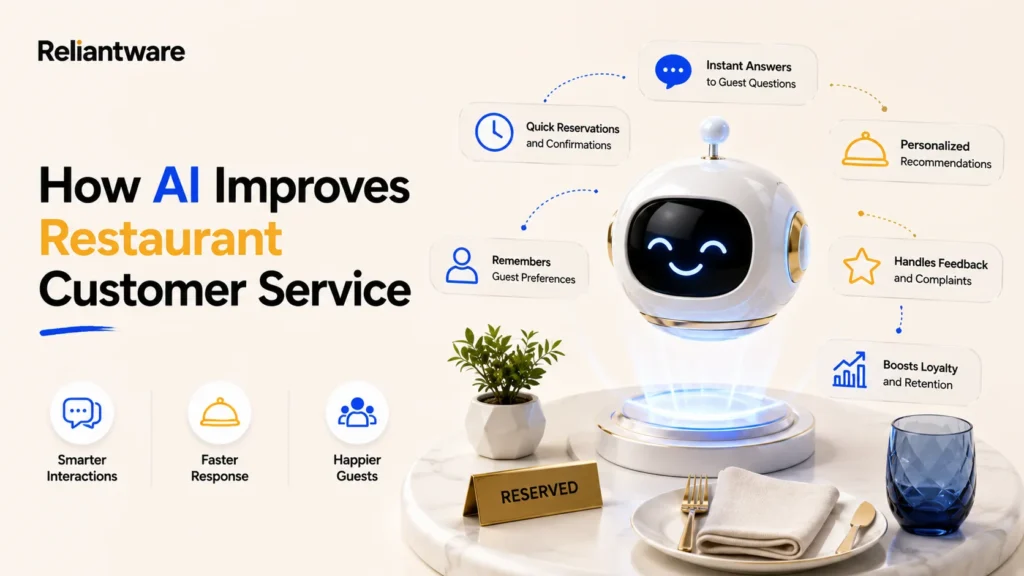
AI improves restaurant customer service by answering calls and questions any hour, catching likely no shows before they cost a table, and cutting order errors at kiosks or drive-thrus. It personalizes recommendations from order history, works across languages for international guests, and scans reviews to flag patterns managers can fix fast. Most tools now come bundled into existing POS platforms, so cost stays low, and a single tool typically shows results within 60 to 90 days. The one limit worth knowing is that allergy or dietary answers still need a human check, not just AI.
This works whether you run one location or several, and none of it replaces staff, it just frees them for the moments guests remember. Reliantware brings real expertise to the next step, turning these service gains into stronger local search visibility.
Key Takeaways
- AI handles calls, chats, and orders around the clock, so nothing gets lost to a missed call or a busy shift.
- Predictive tools catch likely no shows early, protecting table turnover.
- Kiosk and voice ordering cut down modifier mistakes and speed up checkout.
- Personalization uses order history to recommend the right dish to the right guest.
- Review and sentiment tools flag recurring problems, like slow lunch service, before more guests notice.
- Most tools now come bundled into existing POS platforms, keeping cost low.
- A single, well matched tool typically shows results within 60 to 90 days.
- Allergy and dietary questions still need a human check, not AI alone.
- AI does not replace staff, it frees them for the parts of service guests actually remember.
- Reliantware brings genuine expertise to the next step, helping restaurants turn these service improvements into stronger local search visibility.
How AI Chatbots Handle Customer Questions Around the Clock
Do AI chatbots actually help with restaurant customer service? Yes. They answer routine questions instantly, at any hour, without tying up a host or server. A chatbot trained on your hours, menu, and policies can tell a guest at 11pm whether you are open for brunch tomorrow, something no other channel can do without a human on call.
The mechanics are straightforward. Natural language processing models get trained on your FAQs and integrated with your reservation system. A guest texts a question, the bot checks live data, and replies in seconds. Restaurants using this well report a real drop in missed inquiries during closed hours, since the bot never sleeps and never gets pulled away mid conversation.
The tradeoff is simple: AI is great at handling routine questions quickly, but it is not a replacement for genuine hospitality. When a guest has a complaint, a special request, or needs extra care, a real person should step in. The best systems know when to hand the conversation over instead of trying to do everything themselves.
How AI Phone Answering Stops Restaurants From Losing Reservations to Voicemail
How does AI phone answering improve service? It picks up calls your staff physically cannot answer during a rush, and it answers accurately using information pulled from your website and Google Business Profile. A missed call at 7pm on a Friday is a lost table, sometimes a lost customer for good.
Guests move on quickly when no one answers the phone. An AI phone assistant can pick up every call, answer common questions like hours, reservations, or pet-friendly seating, and give consistent, on-brand responses. That means fewer missed booking opportunities while your team stays focused on the guests already in the restaurant.
What AI phone answering can and cannot handle
It handles hours, availability, menu basics, and simple reservation requests well. It should not be the final word on allergy safety or complex dietary questions. Route those to a person, always.
Setting it up without losing the personal touch
Write your own custom responses instead of relying on generic defaults. A response that sounds like your restaurant, not a call center script, keeps the brand voice intact even when a machine answers first.
How AI Personalizes the Guest Experience for Repeat Diners
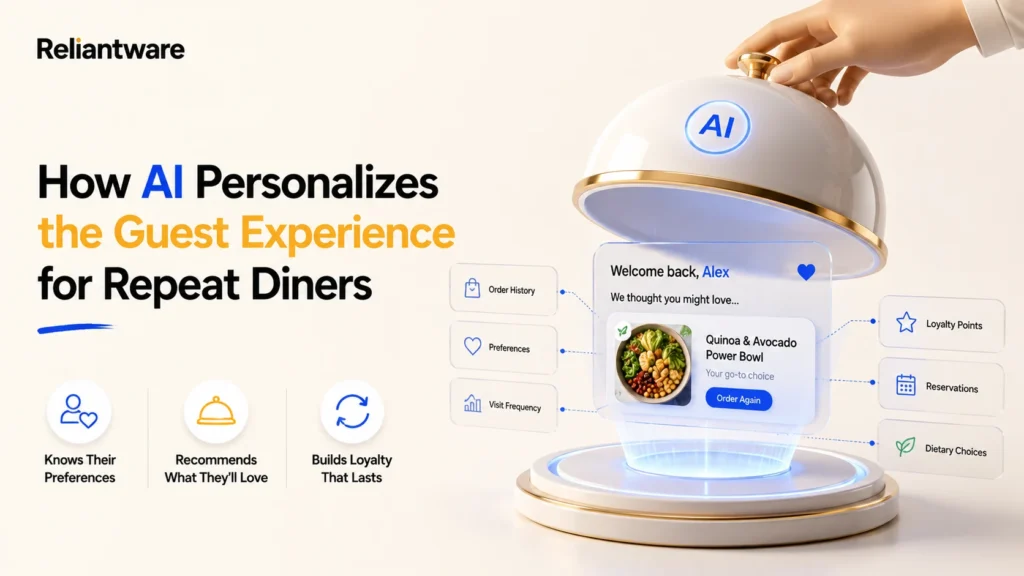
Can AI actually make a restaurant visit feel personal? It can, when it is built on real order history rather than guesswork. A returning guest who always orders the same dish gets a relevant suggestion instead of a generic promo, and that small recognition builds loyalty in a way blanket marketing never does.
Systems that track order history and preferences can prompt a server or a digital menu to surface the right dish at the right moment. A guest who regularly orders plant based meals sees new vegetarian options first, not last. This kind of targeted relevance turns a routine visit into something that feels considered.
The catch is that personalization is only as good as the data behind it. If loyalty, ordering, and reservations all live in separate systems, the restaurant never gets a complete view of the guest. That can lead to recommendations and offers that feel off instead of genuinely personal.
How AI Improves Reservation Management and Cuts No Shows
Does AI reduce restaurant no shows? It reduces them meaningfully by predicting which bookings are at risk and adjusting seating strategy in advance. A six person table booked on a rainy weeknight carries a real no show risk, and AI models that factor in weather, day of week, and party history can flag that risk before it becomes an empty table.
Once a booking looks risky, the system can send an automated reminder or strategically overbook that slot the way airlines do, reassigning a walk in if the original party does not show. Restaurants doing this well see table turnover improve because two top tables get grouped into a four top during peak hours instead of sitting half used.
Predictive reservation tools work best for restaurants that already take a meaningful volume of bookings. A restaurant that runs mostly on walk-ins will not see the same lift, so match the tool to your actual reservation pattern before investing here.
How AI Speeds Up Ordering and Improves Accuracy
Does AI reduce order errors in restaurants? Yes, and the improvement is usually significant. Self service kiosks and voice ordering systems flag impossible modifications before they reach the kitchen, catching things a busy server might miss during a rush.
A drive thru using AI voice ordering repeats the order back for confirmation and sends it straight to the kitchen display system, cutting the back and forth that causes mistakes. Restaurants running this technology report order accuracy climbing well above what manual order taking achieves during peak hours, simply because the system never mishears a modifier the way a person juggling six orders at once might.
Faster ordering also means fewer bottlenecks at checkout. Guests who can order and pay from their phone skip the wait entirely, which matters most during the exact hours when your staff is stretched thinnest.
How AI Helps Restaurants Respond to Reviews and Feedback
Can AI help restaurants manage online reviews? It can, by scanning reviews across platforms, identifying sentiment patterns, and drafting responses a manager only needs to approve. Instead of manually reading through dozens of reviews looking for a pattern, AI surfaces it directly, like a recurring mention of slow lunch service that a manager can act on immediately.
This goes beyond reputation. When restaurants respond to feedback quickly and thoughtfully, they build trust with both customers and search platforms. Better service often leads to better reviews, and strong reviews are a major factor in local visibility. The restaurants that connect great operations with a strong online presence are usually the ones that gain the most long-term value.
Reliantware works specifically in that intersection, helping restaurants turn stronger guest experiences into stronger local search performance so the improvements guests already notice actually translate into more people finding you online. See how Reliantware helps restaurants dominate local search, Get a free audit at Reliantware today.
What AI Customer Service Actually Costs and When You Will See ROI

Is AI customer service expensive for a small restaurant? Less than most owners assume. Many AI features now come bundled into existing POS and reservation platforms rather than requiring a separate standalone purchase, which lowers the barrier for independent restaurants considerably compared to a few years ago. That shift lines up with what the industry is seeing at scale too. Deloitte’s survey of restaurant executives found customer experience is already the area generating the most measurable value from AI investment, one reason eight in 10 restaurant leaders plan to increase their AI spending next year.
Cost typically scales with scope. A single chatbot or AI phone answering tool sits at the lower end of the investment range, while full CRM driven personalization and predictive staffing systems cost more because they pull from multiple integrated data sources. Most restaurants see a meaningful return within 60 to 90 days on a single, well targeted tool, though a chain rolling out multiple systems at once should expect a longer runway before the full picture becomes clear.
The biggest cost mistake is not the tool itself. It is buying several tools at once without a baseline to measure against, then being unable to tell which one actually moved the needle.
Common Mistakes Restaurants Make With AI Customer Service
- Automating everything at once. Piloting one tool against one bottleneck beats a full rollout every time, since a single failure point is far easier to diagnose than five running simultaneously.
- Letting AI answer allergy or health questions unsupervised. This is the one place AI absolutely needs a human backup. A wrong answer here is not a bad review, it is a safety risk, so route these questions to staff without exception.
- Skipping staff training. A tool your team does not understand gets ignored or worked around, wasting the investment entirely.
- Collecting insights but never acting on them. Sentiment data pointing at slow lunch service means nothing if nobody adjusts the schedule.
- Choosing a tool because it is trendy. The right starting tool depends on your actual bottleneck, not on what a competitor down the street installed.
How to Choose Your First AI Tool
- Match the tool to the bottleneck you actually have, not the one that sounds most impressive.
- High volume of missed calls: start with AI phone answering.
- Slow or error prone online ordering: start with kiosk or voice ordering AI.
- Frequent no shows eating into revenue: start with predictive reservation management.
- Strong repeat guest base you want to retain: start with CRM based personalization.
- Pick one. Measure it properly. Expand only once it has proven itself.
Conclusion
AI’s real contribution to restaurant service is not replacing anyone. It is clearing away the repetitive, data heavy work so your staff has room to do the part machines still cannot. Greeting a regular by name. Handling a complaint with genuine warmth. That is the part guests remember, and AI done right protects the time it takes to deliver it.
Better service, of course, only helps your business if people can find you in the first place. See how Reliantware helps restaurants dominate local search,Get a free audit at Reliantware.
FAQs
How does AI improve customer service in restaurants?
It gives instant responses, handles orders and reservations, answers common questions, and personalizes recommendations, freeing staff to focus on in-person hospitality.
Can AI answer phone calls and customer inquiries for a restaurant?
Yes. AI voice assistants answer calls 24/7, share hours and menu details, and handle reservations, transferring complex issues to a human.
Does AI reduce wait times in restaurants?
Yes. It manages reservations, organizes waitlists, forecasts busy periods, and speeds up order processing for smoother seating.
Can AI personalize the dining experience for customers?
Yes. It analyzes past orders and preferences to recommend relevant menu items and promotions, boosting satisfaction and repeat visits.
How does AI improve order accuracy?
AI ordering systems capture requests precisely, confirm modifications, and send orders straight to the kitchen or POS, cutting manual errors.
Can AI handle customer complaints and feedback?
Yes. It can acknowledge complaints, log details, alert staff, and analyze reviews to spot recurring problems worth fixing.
Will AI replace restaurant employees?
No. AI automates repetitive tasks like answering questions and managing reservations, while staff remain essential for hospitality and complex issues.
Is AI affordable for small restaurants?
Yes. Most tools use subscription pricing, letting independent restaurants start with one feature, like a chatbot, and expand later.
How does AI help restaurants increase customer loyalty?
It sends personalized offers, recommends favorites, automates follow ups, and flags customers likely to return, strengthening relationships.
What are the biggest benefits of AI in restaurant customer service?
24/7 support, fewer missed calls, faster responses, better order accuracy, personalization, stronger review management, and lower staff workload.
Empty Tables Cost You $4,000+/Month. Filling Them Costs $0 in Ads.
Hungry diners search Google every night. Show up there, and they come to you.
Free.
Claim your Roadmap now. No obligation