Table of Contents
Best Google Ads for Restaurants Guide in 2026 | Boost ROI
Quick Answer
Google Ads for restaurants works best when you set up conversion tracking first, target a 3–5 mile radius or your delivery zip codes, use negative keywords, combine Local Search with Performance Max, and send visitors directly to your ordering or reservation page. Review performance weekly during the first month, because without conversion tracking, you’re spending money without knowing what’s driving results.
Restaurants that pair Google Ads with a strong SEO strategy see the best long-term growth, and Reliantware helps build that foundation to turn both paid and organic traffic into more customers.
Key Takeaways
- Google Ads puts your restaurant in front of hungry customers within hours, not months.
- Set up conversion tracking before launching anything, or every later decision is a guess.
- Target a 3 to 5 mile radius, or match your delivery zip codes exactly, to avoid wasted spend.
- Build your negative keyword list before your positive one to block irrelevant clicks.
- Run Local Search and Performance Max together for the strongest blended results.
- Bid on your own restaurant name to stop delivery apps from taking a cut of orders already yours.
- Visibility disappears the moment ad spend stops, unlike SEO, which keeps compounding.
- Reliantware combines restaurant SEO with paid strategy know how, helping restaurants build the lasting organic foundation that makes every ad dollar go further.
What Are Google Ads for Restaurants and How Do They Work
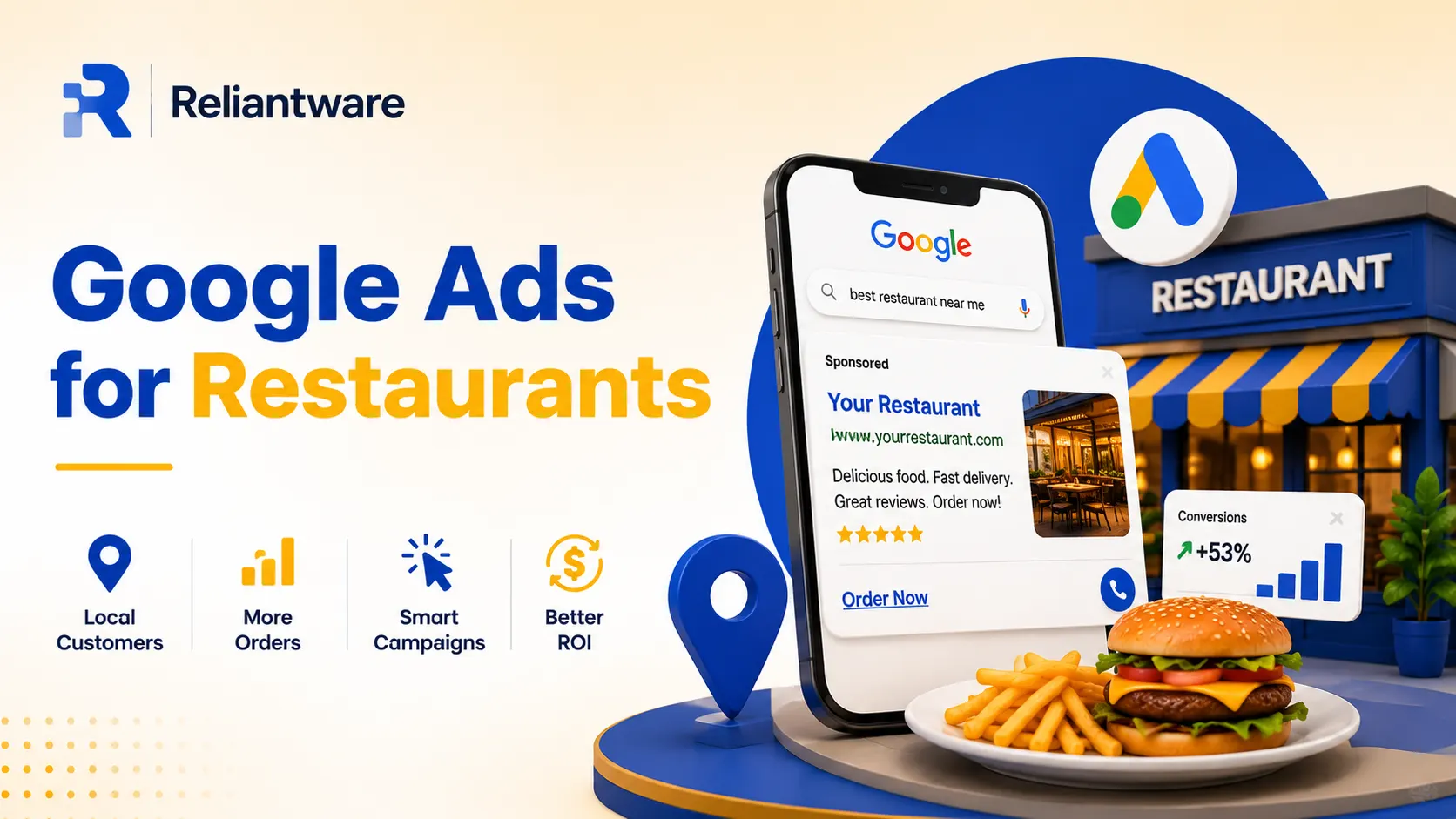
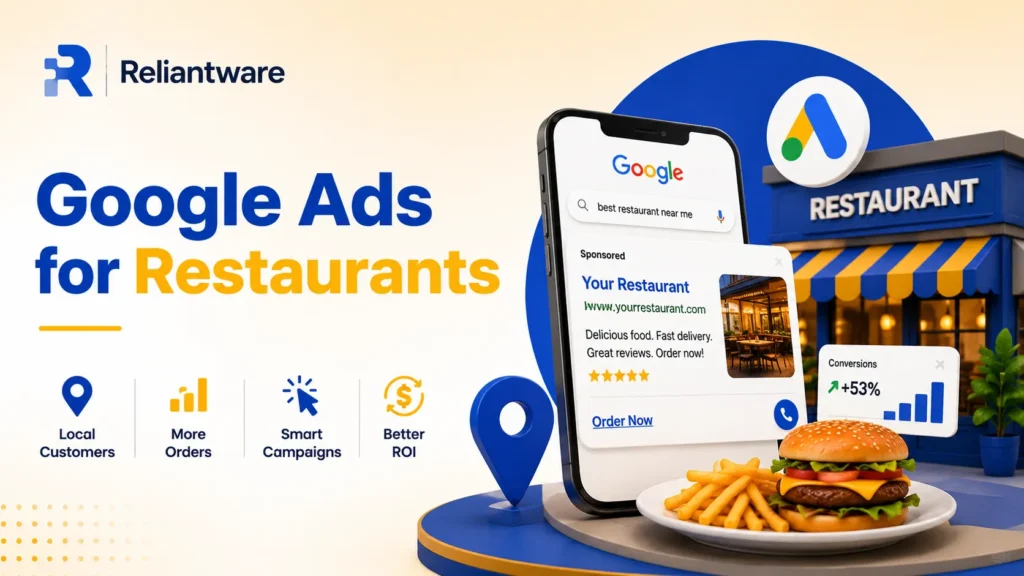
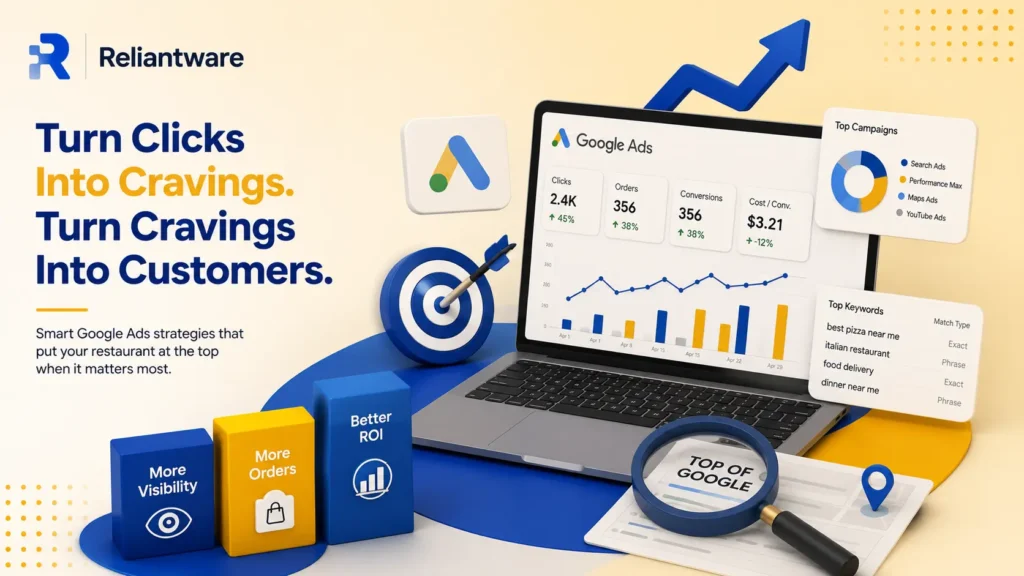
Google Ads for restaurants are paid placements that appear across Google Search, Google Maps, YouTube, Gmail, and partner websites, and they charge you only when someone clicks. That single detail separates them from a billboard or radio spot, where you pay whether anyone notices or not.
Google Ads works like an auction behind the scenes. You bid on keywords people are already searching for, such as “pizza delivery near me,” but the highest bid doesn’t always win. Google also looks at how relevant your ad is and whether your landing page gives people a good experience. That means a restaurant with a well-written ad and a fast-loading menu page can often pay less per click than a competitor spending more on lower-quality ads.
Where do restaurant ads actually appear? Search ads show above organic results on Google. Maps ads appear when someone browses nearby restaurants. Performance Max stretches your ad across Search, Maps, YouTube, Gmail, and Discover from one campaign. Each channel reaches a different moment in someone’s decision, from active searching to passive scrolling.
The Best Google Ads Campaign Types for Restaurants
Not every ad format deserves your budget. Three or four do the heavy lifting.
Local Search campaigns capture people typing exactly what they want, like “sushi near me” or “best burgers downtown.” This is the bottom of funnel traffic. Someone using these words has already decided to eat out tonight. They just need to decide where.
Performance Max campaigns let Google’s machine learning place your ad across Search, Display, YouTube, Gmail, and Discover from a single setup. Restaurants running Search and Performance Max together, rather than one alone, consistently report a lower blended cost per conversion because Performance Max often pulls cheaper inventory from channels beyond Search.
Google Maps ads put your listing at the top when someone browses nearby dining options on their phone. This format earns its budget for walk-in traffic and tourists unfamiliar with the area.
Display and YouTube ads work best for remarketing to people who visited your site and left, or for building appetite before they search at all. A short video of your kitchen or a signature dish plants the idea before hunger even hits.
Call only ads skip the website entirely and let someone tap to call. For restaurants that take reservations by phone or handle large party bookings, this format removes every extra step between interest and a booked table.
How Much Does Google Ads Cost for a Restaurant
Cost per click for restaurant keywords typically runs $1 to $5 in most markets, and $5 to $12 or higher in competitive cities. Monthly spend for a single location usually starts between $500 and $1,500, with growth campaigns climbing past $2,000.
Here is the math behind that number. Monthly cost equals your average cost per click multiplied by estimated clicks per day multiplied by days in the month. A restaurant paying $3 per click with 20 clicks a day spends roughly $1,800 over 30 days. Whether that spend pays off depends entirely on what those clicks turn into.
To measure return, divide total revenue from ads by total ad spend. A campaign generating $9,000 in orders off $1,800 in spend returns 5 to 1, which lands solidly in the profitable range most restaurants aim for.
Market Type | Typical CPC | Monthly Budget Range |
Small market, low competition | $1 to $3 | $500 to $800 |
Mid size city | $3 to $6 | $800 to $1,500 |
Highly competitive city | $6 to $12+ | $1,500 to $5,000+ |
How to Set Up Your First Restaurant Google Ads Campaign
Start at ads.google.com and create an account with billing attached. From there, the sequence matters.
Pick your campaign goal first, whether that is online orders, reservations, or store visits. Choose Search as your campaign type and turn on location extensions so your address and map appear inside the ad. Set your geo target to a 3 to 5 mile radius, since targeting an entire city wastes budget on people who will never drive to you.
Build your keyword list around high intent phrases like “[cuisine] near me” and “best [dish] in [city],” then immediately add negative keywords before launching anything. Write an ad copy with a clear action, something like “Order Online” or “Reserve Your Table,” and set a modest daily budget of $10 to $20 while you gather early data. Launch, then check performance daily for the first week.
Should You Bid on Your Own Restaurant's Name
Yes, and overlooking this step can quietly cost restaurants money every month. If you don’t bid on your own restaurant name, delivery apps or competitors can place ads above your organic listing and capture customers who were already looking for you. Those platforms may then take a 15–30% commission on orders that could have come directly to your restaurant. It’s one of the easiest and most preventable ways to lose revenue from your marketing efforts.
A brand protection campaign for your own name typically costs very little, since you are the only relevant advertiser bidding on it, and the return on that small spend is close to guaranteed.
Google Ads vs SEO for Restaurants: Which Actually Gets You More Customers
They solve different problems, and the honest answer is you need both working at the same time, just in different proportions depending on where your restaurant stands today.
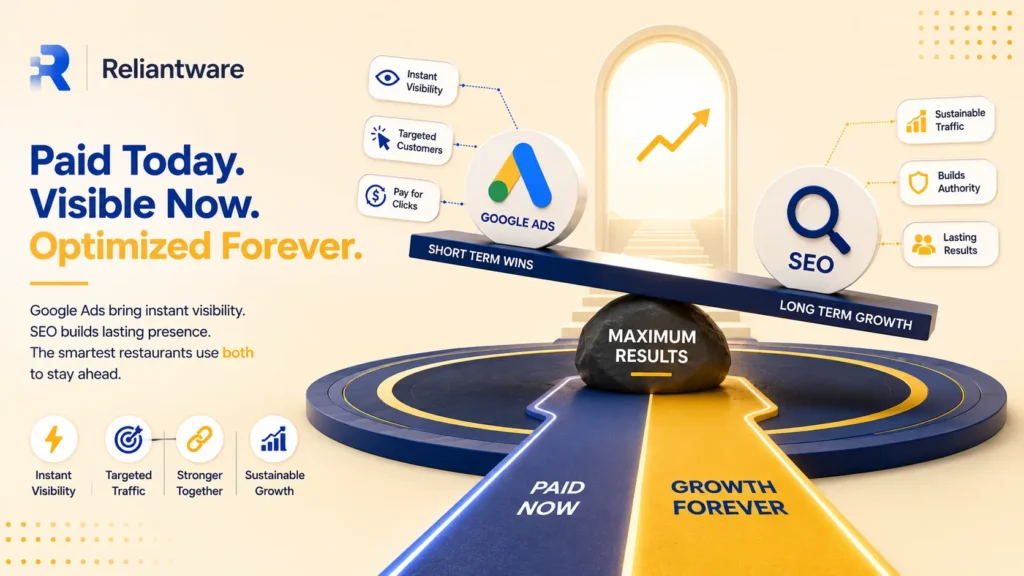
Google Ads can put your restaurant in front of potential customers almost immediately. SEO, on the other hand, takes time but continues driving traffic long after the initial work is done. They aren’t competing strategies—they work best together. For a new restaurant with little online presence, Google Ads can bring in early customers while SEO builds the long-term visibility that gradually reduces the need to rely on paid ads.
Factor | Google Ads | Restaurant SEO |
Speed to results | Hours to days | Weeks to months |
Cost structure | Pay per click, ongoing | Upfront work, then largely free traffic |
Longevity after spend stops | Visibility ends immediately | Rankings persist and compound |
Trust signal to customers | Labeled as an ad | Organic result, higher perceived trust |
Best use case | New openings, promotions, fast tests | Long term local visibility and reviews |
How should you split a limited budget? A brand new restaurant with no reviews and a thin website should lean toward 70 percent ads, 30 percent SEO foundation work, since paid traffic buys time while organic signals build. An established restaurant with strong reviews and years of local search history can flip that ratio, often running 30 percent ads for promotions and new menu launches while SEO carries the bulk of steady traffic at a fraction of the ongoing cost.
This is exactly the gap most restaurants fall into. They keep paying for clicks year after year because nobody built the organic foundation underneath them. See how Reliantware helps restaurants dominate local search, Get a free audit at Reliantware.
Common Mistakes Restaurants Make With Google Ads
Targeting an entire city instead of a tight radius wastes the largest share of most restaurant budgets. Ignoring negative keywords comes next, since without them your ad shows up for searches like “recipe” or “restaurant jobs” that will never convert. Sending traffic to a general homepage instead of a direct ordering or reservation page adds friction that kills conversions before they happen.
Skipping conversion tracking means you are optimizing blind, unable to tell which keywords actually drive orders. And treating a campaign as set and forget, rather than checking it weekly, lets underperforming keywords quietly drain the budget for months before anyone notices.
What Happens When You Stop Paying for Google Ads
The honest truth is your visibility disappears the moment you stop paying. There is no residual effect, no lingering ranking, nothing carried forward. This is the fundamental tradeoff of paid search, and it is exactly why Google Ads works best as an accelerant rather than a permanent strategy on its own. Restaurants relying entirely on ads without any SEO foundation underneath them are, in effect, renting their visibility rather than owning it.
Negative Keywords Every Restaurant Should Use
Before adding your target keywords, build a solid negative keyword list. Include terms like recipe, how to make, jobs, careers, hiring, calories, free, and equipment, along with any cuisine or service you don’t offer, such as delivery if you’re dine-in only. If you run a high-end restaurant, it’s also smart to exclude searches like cheap, discount, and coupon so your budget goes toward customers who are actually a good fit.
How to Know If Your Campaign Is Working: KPIs to Track
Track return on ad spend above everything else. For most restaurants, 3 to 5 times return means you are roughly breaking even after food costs, 5 to 7 times means real profit, and 7 times or higher means the campaign is genuinely working well. Cost per order matters just as much. Divide ad spend by number of orders and compare that figure against your average order value. Calls, direction requests, and reservations round out the picture, since a click that never converts into one of these actions was money spent without a customer gained.
Conclusion
Google Ads puts hungry customers in front of your restaurant within hours, not months. That speed makes it worth running, especially for new openings and seasonal promotions. But the moment the spend stops, so does the visibility. Building SEO underneath your paid campaigns is what turns a short term traffic spike into steady, compounding growth that keeps bringing customers through the door long after this month’s ad invoice is paid.
See how Reliantware helps restaurants dominate local search. Get a free audit at Reliantware.
FAQs
Is Google Ads worth it for restaurants?
Yes. It helps restaurants reach customers who are actively searching for a place to eat and can generate results quickly when set up correctly.
What is the 30-30-30 rule for restaurants?
It’s a budgeting guideline that allocates about 30% each to food, labor, and overhead, leaving around 10% as profit.
Is $100 enough for Google Ads?
Yes, for a small test campaign. It can provide useful data but isn’t enough for long-term growth in competitive markets.
How do I advertise a restaurant on Google?
Create a Google Ads account, target your local area, use relevant keywords, and send visitors to your ordering or reservation page.
Is $20 a day good for Google Ads?
Yes. It’s a solid starting budget for most single-location restaurants to test and optimize campaigns.
How do I get my restaurant to show up on Google?
Optimize your Google Business Profile, improve local SEO, and use Google Ads if you want immediate visibility.
Is $10 a day good for Google Ads?
It can work in low-competition areas but may not generate enough traffic in larger or more competitive markets.
What are the disadvantages of Google Ads?
Traffic stops when your budget runs out, and poorly managed campaigns can waste money on irrelevant clicks.
Why did Google Ads charge me $500?
Google charges based on your ad spend, billing threshold, or billing cycle—not a fixed fee. Check your billing summary for details.
Empty Tables Cost You $4,000+/Month. Filling Them Costs $0 in Ads.
Hungry diners search Google every night. Show up there, and they come to you.
Free.
Claim your Roadmap now. No obligation