Table of Contents
How to Choose Best Restaurant Social Media Marketing Agency in 2026
Quick Answer
The best restaurant social media marketing agency ties content and ads to reservations, not followers, covering photography, video, paid ads, influencers, and KPI reporting. Expect 750 to 2,000 dollars monthly for one location, 2,500 to 7,000 for multi location groups, more for franchises, plus ad spend. Vet on KPIs, who shoots your content, case study depth, hyperlocal ad experience, and contract exit terms. Tight budgets often do better with a freelancer, growing brands need agency bandwidth. Engagement moves in a month, reservations in two to three.
Most agencies miss connecting that visibility to local and AI search, which is where Reliantware helps restaurants get found and recommended, not just liked.
Key Takeaways
- The best agency measures reservations and orders, not followers or likes
- Full service management runs 750 to 2,000 dollars monthly for one location, more for multi location or franchise groups
- Vet every agency on five points: KPIs, content capture, case studies, hyperlocal ad experience, and contract terms
- Freelancers can work for tight budgets, agencies suit brands needing full bandwidth
- Engagement grows within a month, real reservation gains take two to three months
- Social visibility alone is not enough. Reliantware connects that visibility to local search and AI search so restaurants get found and recommended, not just liked
What Does a Restaurant Social Media Marketing Agency Actually Do
A restaurant social media marketing agency manages your content, advertising, and community engagement across platforms like Instagram, TikTok, and Facebook to drive reservations and orders, not just impressions. The best ones treat social media as one piece of a larger visibility system rather than an isolated task.
Core services typically include food photography and short form video production, Instagram and TikTok content calendars, paid Meta and TikTok advertising, influencer and local creator partnerships, review and comment management, and monthly reporting tied to business outcomes.
Facebook remains the most widely used platform among restaurant owners themselves for business promotion, according to TouchBistro’s Restaurants Report, which makes it a baseline channel any agency should already have covered before pitching anything more advanced.
A specialized agency understands something a generalist marketing firm often misses. Restaurants move fast. Menus change seasonally, events pop up with two weeks notice, and a slow Tuesday needs a promotion by Thursday. General agencies built for retail or B2B clients rarely move at that speed.
The honest truth is that content quality alone will not save a weak strategy. A gorgeous photo of your short rib special does nothing if it never reaches anyone who is actually hungry and nearby right now.
What the Best Agencies Deliver vs What Average Ones Deliver
This is where most restaurant owners get fooled. An agency that reports rising follower counts every month sounds like it is working. It might be doing almost nothing that matters.
Vanity Metrics | Revenue Metrics |
Follower growth | Reservation clicks from social profiles |
Likes and comments | Online ordering conversions from social ads |
Impressions | Cost per acquisition on paid campaigns |
Story views | Return on ad spend |
Post frequency | Repeat visit rate tied to loyalty or email signups |
Great agencies measure success using business KPIs. Average agencies measure success using numbers that are easy to report and hard to tie back to your bottom line.
An agency that only promises follower growth is not lying to you exactly. It is just answering a question you should not have asked in the first place.
How Much Does a Restaurant Social Media Agency Cost
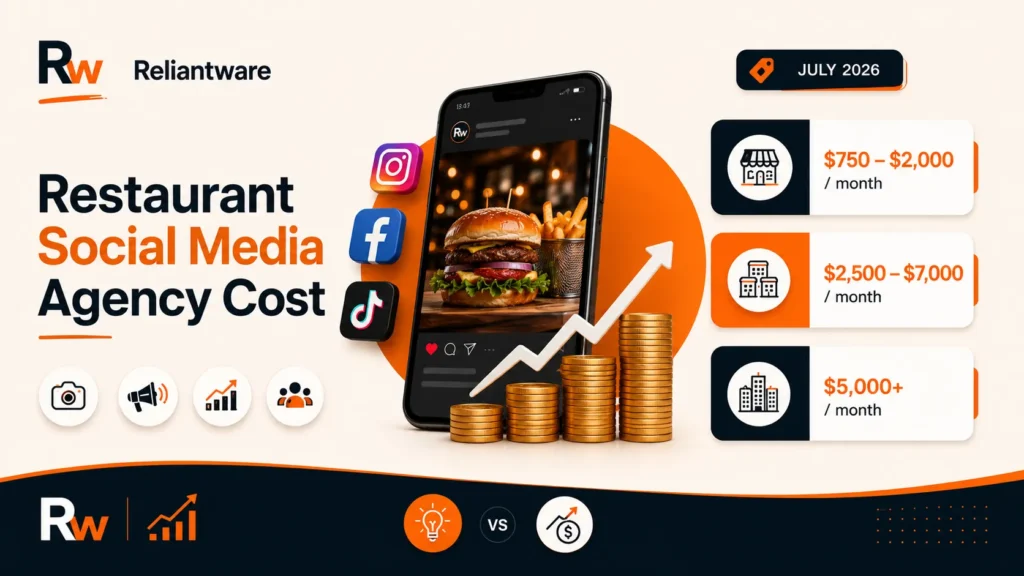
Pricing varies widely and depends heavily on scope, platform count, and whether paid advertising is included on top of management fees.
Independent restaurants with a single location typically spend $750 to $2,000 per month on social media management, covering essentials like content creation and regular posting. Small restaurant chains often invest $2,500 to $7,000 per month for more comprehensive services, such as paid advertising, video content, and influencer campaigns. Larger franchise brands can spend $5,000 or more monthly on full-scale, multi-platform marketing. Keep in mind that advertising budgets are usually billed separately from management fees, and pricing varies by agency, location, and the scope of services.
For most restaurants, the biggest mistake is not overspending. It is underspending on content capture while overspending on ad boost, which produces polished ads pointing at thin, repetitive content.
How to Vet an Agency Before You Sign
Score every agency you talk to against these five criteria. Anything below a 3 out of 5 on two or more points is a real warning sign.
Content Capture Logistics: Ask whether the agency regularly visits your restaurant to capture fresh photos and videos of your food, staff, and atmosphere, or if they rely on images you send. Agencies that create content on-site typically produce more authentic, engaging posts that stand out in crowded social feeds.
Local Influencer Access. A restaurant focused agency should already have relationships with local food creators. If they have to start building that network from scratch after you sign, you are paying for their education.
Hyperlocal Ad Experience. Dining decisions get made locally. The agency should have specific, demonstrated experience running geofenced ads targeting people within a few kilometers of your location, not generic national campaign templates.
Case Study Depth. Ask for a case study that names a real reservation, revenue, or booking number, not just an engagement percentage. If every example stops at “increased engagement,” push further.
Reporting Cadence. Monthly reports should tie directly to business goals. If reporting only shows charts of likes and impressions with no commentary on reservations or orders, that agency is measuring the wrong thing.
I could be wrong about any single agency claiming to check every box here. But an agency that resists these five questions, or answers vaguely, is telling you something important about how the engagement will actually go.
How Social Media Connects to Local SEO and AI Search Visibility
Here is the part most social media agencies never mention, mainly because it sits outside what they sell. Social content and search visibility are not separate games. They compound each other.
A strong Instagram presence can spark interest, but it’s only part of the customer journey. If someone later searches “best Italian restaurant near me” on Google or asks an AI tool for a recommendation and your restaurant doesn’t appear, you’re likely losing potential diners. Today’s customers discover restaurants across multiple platforms before deciding where to eat, so being visible on social media alone is no longer enough.
This is exactly where Reliantware fits into the picture differently from a social first agency. Reliantware focuses on restaurant SEO and AI search visibility, making sure your restaurant is the answer whether someone searches on Google or asks ChatGPT or Gemini where to eat tonight. If you already have a social media agency handling your content and want the search and AI visibility side covered too. Get a free audit at Reliantware and see exactly where your restaurant is losing local search traffic.
Agency vs Freelancer vs In House
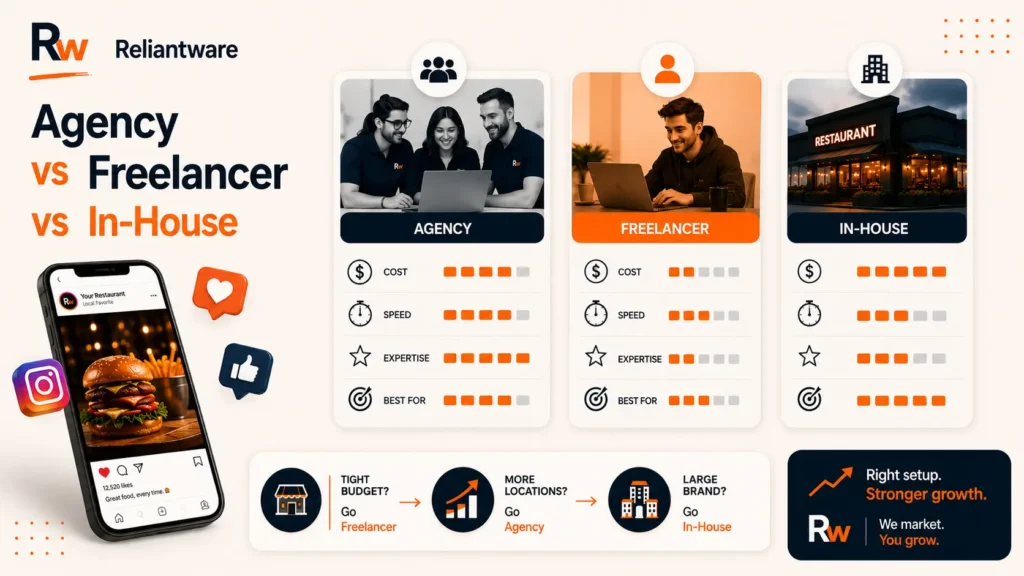
Agency | Freelancer | In House | |
Cost | Higher, but full team access | Lower, single skill set | Highest, salary plus tools |
Speed | Fast, dedicated resources | Depends on availability | Fast, but limited bandwidth |
Expertise | Broad, across content and ads | Narrow, usually one strength | Varies by hire |
Best for | Restaurants wanting full strategy | Restaurants on tight budgets | Multi unit brands with scale |
For a single-location restaurant with a limited budget, one experienced freelancer managing Instagram may be the most cost-effective option. But as your business grows to multiple locations, an agency becomes a better fit. Managing content creation, paid ads, review responses, and performance tracking across several restaurants is usually more than one person can handle consistently.
Common Mistakes Restaurants Make
- Chasing follower counts instead of reservation numbers wastes budget on the wrong scoreboard
- Skipping the content capture conversation leads to agencies posting stock photography that looks nothing like your actual dining room
- Ignoring local SEO while investing heavily in social means half your visibility strategy is missing entirely
- Signing long contracts without an exit clause locks you into underperformance for months
- Treating every platform the same, rather than adjusting strategy for TikTok versus Instagram versus Facebook, spreads effort thin without building strength anywhere
How to Choose the Right Agency for Your Restaurant
Start by defining what “success” means in dollars, not likes. Set a monthly budget range based on your restaurant size using the pricing snapshot above. Interview at least two agencies using the five point vetting framework. Ask each one directly how they would measure results in month one, three, and six. Then check whether their answer includes your local search visibility, not just your social feed. The agency that treats these as connected, rather than separate line items, is usually the one that understands the full picture of how diners actually find you.
The best restaurant social media marketing agency for a twelve table neighborhood spot looks nothing like the best one for a fifteen location franchise. Match the agency to your actual scale, not the name recognition of their client roster.
Conclusion
Choosing the best restaurant social media marketing agency comes down to one question. Can they prove the connection between what they post and who walks through your door. Followers and likes are easy to report and easy to fake with the right ad spend. Reservations and repeat visits are not.
If your social strategy is solid but your restaurant still is not showing up when people search Google or ask an AI tool where to eat, that is a search visibility gap, not a content gap. See how Reliantware helps restaurants dominate local search. Get a free audit at Reliantware today.
FAQs
How much does a restaurant social media marketing agency cost?
750$ to 2,000$ monthly for independent restaurants, 2,500$ to 7,000$ or more for multi location groups, excluding ad spend.
What does a restaurant social media marketing agency do?
Creates content, manages accounts, runs paid ads, coordinates influencers, and reports on reservations and orders, not just engagement.
How do I choose the best restaurant social media marketing agency?
Look for restaurant experience, real revenue case studies, professional photography, local ad expertise, and reporting tied to growth, not followers.
Is hiring a restaurant social media marketing agency worth it?
Yes, when it targets measurable outcomes like brand awareness, local diners, and reservation growth rather than vanity metrics.
How long does it take to see results from restaurant social media marketing?
Engagement improves within 30 days. Reservation and order growth typically takes two to three months.
What should a restaurant social media marketing agency measure?
Reservations, online orders, website traffic, cost per reservation, return on ad spend, and repeat visits, not just followers.
Can social media marketing help my restaurant rank higher on Google?
Indirectly, through brand awareness, site traffic, and reviews. Pair it with a dedicated local SEO strategy for best results.
Should I hire a freelancer or a restaurant social media marketing agency?
Freelancers suit small budgets. Agencies fit growing or multi location brands needing full content, ad, and analytics support.
Empty Tables Cost You $4,000+/Month. Filling Them Costs $0 in Ads.
Hungry diners search Google every night. Show up there, and they come to you.
Free.
Claim your Roadmap now. No obligation