Table of Contents
10 Proven Tactics to Improve Restaurant Customer Service in 2026
Quick Answer
Great restaurant customer service means fast, honest greetings, checking back within two minutes of food arriving, and giving staff real authority to fix problems on the spot with a comp budget of roughly $20 to $50 for sit down or $5 to $15 for quick service. Automate the friction like payments and waitlists, but keep the greeting and recovery human, train staff regularly, and measure results through review response time and repeat visits rather than star ratings alone.
None of it fills tables, though, if guests can’t find the restaurant online first, and that’s the gap Reliantware closes for restaurants trying to turn good service into a full dining room.
Key Takeaways
- Greet every guest within 4 feet in the first 30 seconds, and always give honest wait times.
- Check back within two minutes or two bites of food arriving to catch problems early.
- Give staff real authority to comp $20 to $50 (sit down) or $5 to $15 (quick service) without needing manager approval.
- Automate payments and waitlists, but keep greetings and recovery conversations human.
- Train staff regularly on these frameworks so service doesn’t depend on one star employee.
- Track review response time and repeat visit rate, not just star ratings.
- Great service only fills tables if people can find the restaurant first, and that’s where Reliantware earns its keep for restaurant clients.
What Is Restaurant Customer Service, Really
Restaurant customer service is every interaction a guest has with your staff, your systems, and your brand, before, during, and after they eat.
It comes down to three things. Speed matters because no one likes waiting without knowing why. Accuracy matters because a wrong order can break trust in an instant. And human connection matters because it is what turns a guest who simply ate a meal into one who leaves happy and tells five friends about the experience.
Here is where most owners get it wrong. They treat these three pillars as separate checkboxes. They are not. A fast but robotic table interaction fails the emotional pillar. A warm greeting followed by a 40 minute wait for food fails the speed pillar. Real service means all three working together, every table, every shift.
Consider a diner ordering a dish they have never tried before. Speed alone gets their food out quickly. Accuracy alone gets the order right. But it is the server who notices hesitation and offers a genuine recommendation who creates the moment that gets remembered.
The Restaurant Guest Journey, Stage by Stage
The guest journey is the sequence of moments a diner experiences, from walking in to walking out, and every stage carries its own risk of losing them.
Treat it as a timeline with actual deadlines, not a vague vibe you hope your staff nails.
The First 30 Seconds
The 10/4 rule works well here. Acknowledge a guest with eye contact or a smile from 10 feet away. Greet them verbally within 4 feet. This single habit prevents the most common early complaint in the industry: feeling invisible at the host stand.
If a table is not ready, say so honestly. Give a real wait estimate, not an optimistic guess. A guest told 20 minutes and seated in 15 feels great. A guest told 10 and seated in 20 feels lied to.
The Check In Window
Once seated, the two minute, two bite rule applies. Check back with the table within two minutes of food arriving, or after their second bite, whichever comes first. This catches a cold dish or a wrong temperature before the guest has decided to just eat around it and complain later.
Great service is proactive, not just reactive. Refill water before the glass is empty. Bring extra napkins before a messy dish arrives. If a family walks in with young children, offer crayons or a kids’ menu before they have to ask. Small gestures like these make guests feel noticed and cared for.
Service Recovery: What to Do When Something Goes Wrong
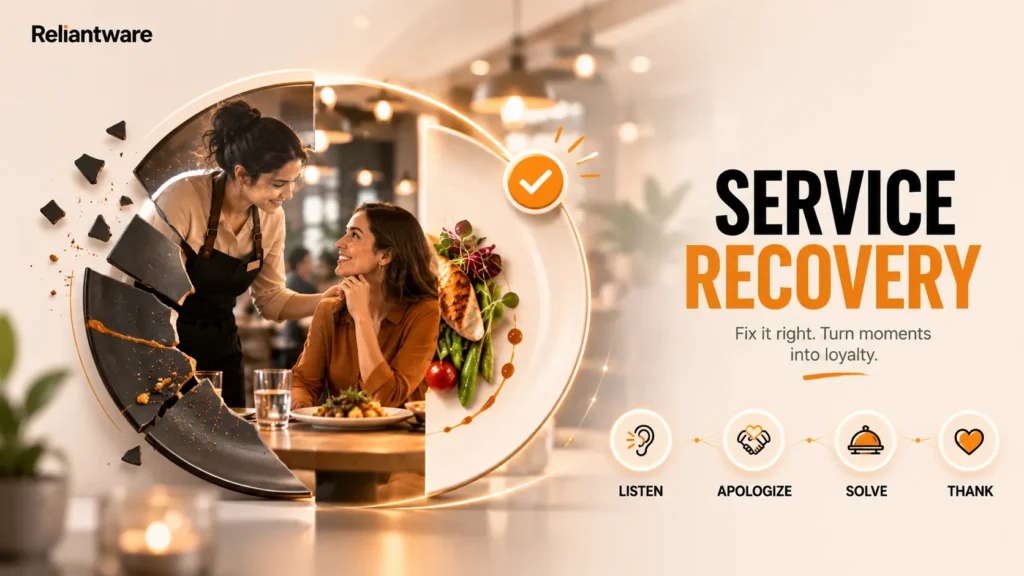
Mistakes will happen. A steak comes out wrong. A drink order gets lost during a rush. What separates a restaurant that keeps its regulars from one that bleeds them is not the mistake itself. It’s the recovery.
The four step method works consistently: Listen, Apologize, Solve, Thank.
|
Step |
Action |
Example |
|
Listen |
Let the guest finish speaking without interrupting or getting defensive |
Maintain eye contact, nod, do not explain yourself yet |
|
Apologize |
Give a specific, sincere apology |
“I’m sorry your steak came out overcooked. That’s not our standard.” |
|
Solve |
Offer a concrete fix with a real timeline |
“I’ll have the kitchen fire a fresh one. Six minutes.” |
|
Thank |
Thank the guest for speaking up |
“Thank you for telling me. It helps us fix it at the moment.” |
Honest limitation here: this method only works if staff actually have the authority to act on step three without hunting down a manager first. A server who has to say “let me go ask” during a complaint has already lost the moment. The next section fixes that gap directly.
How Much Should a Restaurant Comp for a Mistake
This is the question almost every source dodges, and it matters because vague guidance leads to inconsistent recovery.
A workable range for most sit down restaurants is $20 to $50 in comp value per incident, authorized directly by the server or shift lead without needing manager sign off first. That might mean a free round of drinks, a comped dessert, or 20 percent off the check depending on the severity of the issue.
The reasoning is simple. A resolved complaint, handled fast and generously, often creates a more loyal guest than a meal that went perfectly. A guest who leaves angry rarely comes back and rarely stays quiet about it online. A guest whose problem got fixed on the spot tends to tell people about that instead.
In quick-service restaurants, the comp threshold is often lower, usually around $5 to $15. Because the average order is smaller, resolving the issue quickly is often more important than making a large gesture.
Where Technology Helps and Where It Gets in the Way
QR code ordering, digital waitlists, and online booking all reduce administrative friction. Use them for exactly that. Paying the bill, splitting a check, joining a waitlist. These are tasks nobody enjoys doing manually, and automating them frees up staff time for the parts that actually need a human.
Where technology backfires is when it replaces the greeting, the check in, or the recovery conversation. Some guests simply don’t want to handle a complaint through a tablet. Research on self-service kiosks also suggests that some diners can feel rushed or uncertain when navigating the menu, which can take away from the welcoming experience a restaurant is trying to create.
The rule that holds up: automate the friction, keep the hospitality human. And none of these systems matter if guests never find the restaurant to begin with. Reliantware helps restaurant clients build exactly that kind of visibility in local and AI powered search: Get a free audit at Reliantware.
Core Customer Service Skills Every Server Needs

Great service doesn’t come from personality alone. It comes from a specific set of skills that any server can learn and practice.
Communication. Servers need to explain menu items, answer questions about ingredients or allergens, and relay accurate information to the kitchen. A guest with a shellfish allergy should never have to double check an order twice.
Attentiveness. Noticing an empty water glass or a guest scanning the room for their server before they have to flag someone down. This is what makes service feel anticipatory instead of reactive.
Product knowledge. A server who has actually tasted the dishes can answer real questions and make genuine recommendations, not just point at the menu.
Problem solving. When something goes wrong, servers need to think on their feet and apply the recovery steps covered above, calmly and without waiting on a manager for every decision.
Time management. Juggling multiple tables during a rush without letting any one guest feel forgotten. This skill alone separates a server who thrives on a busy Friday night from one who falls behind.
These five skills are what training should actually build toward, not vague reminders to “be nice” or “smile more.”
Training Staff So Good Service Doesn't Depend on One Person
Relying on your best server to carry the floor is not a strategy. It’s a liability the moment they call in sick.
Build training around the actual frameworks above, not generic customer service platitudes. Role play the 10/4 greeting. Practice the four step recovery method out loud, including how it sounds when a guest is genuinely upset. Walk new hires through the comp authority so they know exactly what they can offer without asking permission mid shift.
Run this training regularly, not as a one time onboarding session. Menus change, staff turn over, and standards slip quietly if nobody reinforces them.
How to Actually Measure Restaurant Customer Service Quality
Most restaurants track star ratings and stop there. That’s the surface level. Star ratings tell you the outcome, not the cause.
A more useful set of metrics includes review response time, since guests notice whether a restaurant replies within a day or ignores feedback entirely. BrightLocal’s 2026 consumer research found that most diners now expect businesses to reply to reviews, and ratings under 4.5 stars are increasingly filtered out before a guest ever considers the restaurant. Repeat visit rate tells you whether the experience actually earns return trips, not just a single good meal. And direct table feedback, gathered through a quick comment card or a genuine question at the table, surfaces problems before they ever hit a review site.
Common Mistakes Restaurants Make With Customer Service
- Treating staff worse than guests, which shows up in service quality within days
- Giving no comp authority to servers, so small problems escalate while a guest waits for a manager
- Automating the greeting away entirely, replacing a human welcome with a screen
- Collecting feedback and never acting on the patterns it reveals
- Ignoring the speed expectation that quick service guests carry into every visit
Conclusion
Great restaurant customer service is not a personality some servers happen to have. It’s a system, built on real time windows, clear recovery authority, and honest measurement, that any trained staff member can run consistently. Get that system right and the reviews, the regulars, and the referrals follow.
See how Reliantware helps restaurants dominate local search. Get a free audit at Reliantware today!
FAQs
What is customer service at a restaurant?
It’s every interaction between staff and guests, from greeting and ordering to resolving problems and following up after the meal.
What's the best way to complain at a restaurant?
Speak to a server or manager calmly and specifically about what went wrong while you’re still there. That gives staff the best chance to fix it on the spot.
Is a restaurant working customer service?
Yes. Restaurants run on service constantly, since every table interaction, phone call, and online review is a customer service touchpoint.
What are good customer service examples?
A server remembering a regular’s usual order, a host giving honest wait times, or a manager comping a dish immediately after a mistake.
What is good customer service in a restaurant?
Fast, accurate, and warm service that makes guests feel valued and handles problems quickly when they happen.
What are the top 3 skills of customer service?
Communication, attentiveness, and problem solving. Together they cover explaining things clearly, noticing needs early, and fixing issues fast.
What are 5 common customer service problems?
Long wait times, wrong orders, unresolved complaints, inattentive staff, and inconsistent service across shifts.
What are the 4 types of customers in customer service?
New customers, regulars, loyal advocates, and dissatisfied customers, each needing a slightly different approach to keep them coming back.
Empty Tables Cost You $4,000+/Month. Filling Them Costs $0 in Ads.
Hungry diners search Google every night. Show up there, and they come to you.
Free.
Claim your Roadmap now. No obligation